Remote Sales Hiring
Top 7 Tips for Conducting Successful Remote Interviews
Amir ReiterAugust 30, 2024

Remote hiring has become essential as more and more look for remote positions, but many companies struggle to conduct them effectively.
Poor remote interviewing practices lead to miscommunication, missed opportunities, and potentially hiring the wrong candidates. These missteps can result in wasted time, resources, and even damage to your company’s reputation.
The stakes are high in the talent market. A LinkedIn survey found that 83% of talent say a negative interview experience can change their mind about a role or company they once liked. The challenges are amplified for remote interviews, with technical issues and the lack of in-person interaction adding complexity to the process.
But there’s good news. By implementing the right strategies, you can transform your remote interviews into powerful tools for identifying and attracting top talent.
This blog outlines seven actionable tips to streamline your remote interview process during 2024, ensuring you connect with the best candidates and make informed hiring decisions.
Tip 1: Research and Personalize the Remote Interview Experience
Personalization sets the foundation for a successful remote interview. Going beyond the resume allows you to create a more engaging and insightful conversation with your candidate.
Tailoring your approach demonstrates your interest and helps you gain a deeper understanding of the applicant’s potential fit within your organization.
Here’s how you can personalize your remote interviews:
- Review the candidate’s online presence, including LinkedIn profiles and portfolio sites, to gather additional insights.
- Prepare questions that relate to specific projects or experiences mentioned in their application materials.
- Take note of any shared interests or experiences that could help build rapport during the interview.
- Use the candidate’s background to frame questions about how their past experiences align with your company’s goals and culture.
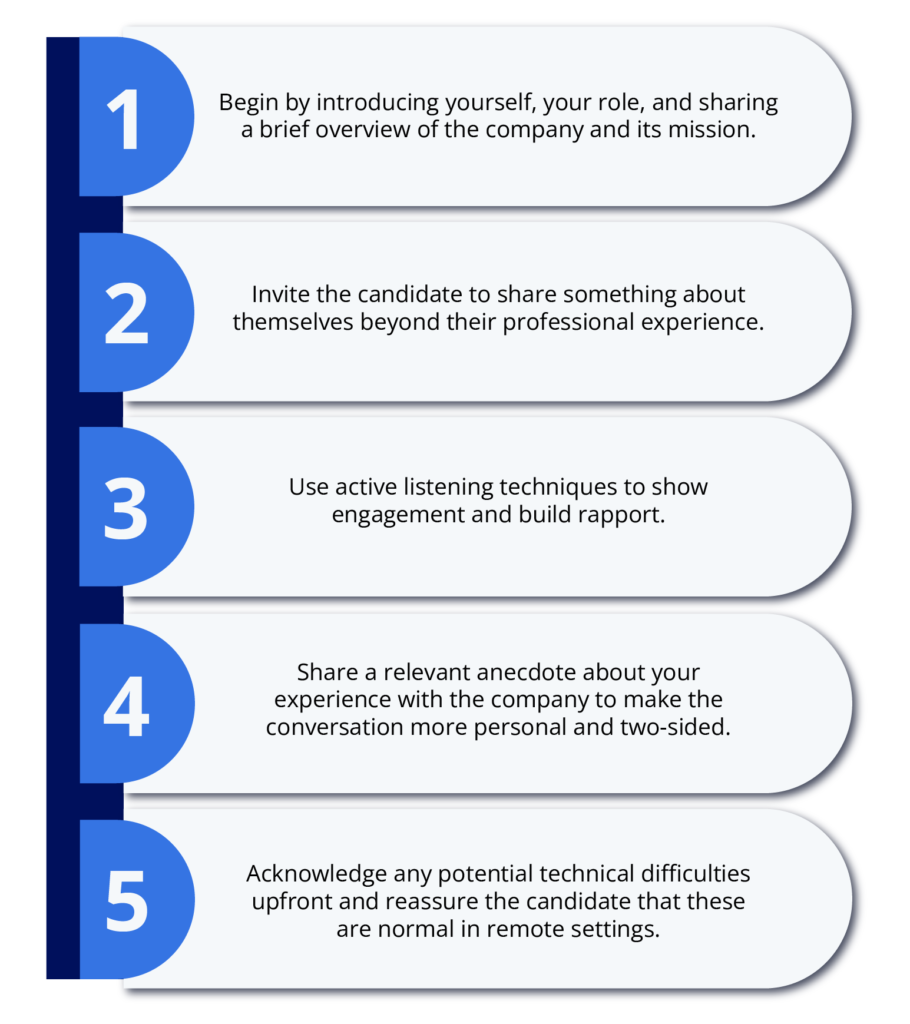
Tip 2: Start with Genuine Connection
The first few minutes of a remote interview are crucial for setting the right tone.
According to a study by Robert Half, 91% of executives say the first few minutes of an interview can determine the outcome. Creating a welcoming atmosphere helps candidates relax and present their best selves.
Remember, your goal is to understand the person behind the resume and assess how they might contribute to your team.
Here are some strategies to establish a genuine connection:
Tip 3: Mix Technical and Situational Questions
Effective remote interviews require a balanced approach to questioning.
Combining technical queries with situational scenarios provides a comprehensive view of a candidate’s capabilities. The method allows you to assess both hard skills and problem-solving abilities, which are crucial for success in remote roles.
Incorporating both technical and situational questions creates a more robust evaluation process.
Here’s how to implement this approach:
- Prepare a mix of specific, technical questions related to the role’s requirements.
- Develop situational questions based on real challenges your team has faced.
- Ask candidates to walk you through their problem-solving process for hypothetical scenarios.
- Use the STAR method (Situation, Task, Action, Result) to structure behavioral questions.
- Balance the interview with approximately 60% technical and 40% situational questions.
When crafting your questions, consider including:
- Role-specific technical questions (e.g., “Can you explain how you would optimize a sales funnel using our CRM?”)
- Remote work scenarios (e.g., “How would you handle a miscommunication with a team member in a different time zone?”)
- Cultural fit questions (e.g., “Describe a time when you had to adapt to a new work culture. How did you approach it?”)
- Problem-solving queries (e.g., “If a client suddenly changed project requirements, how would you adjust your approach?”)
Tip 4: Encourage Two-Way Communication
Remote interviews should be collaborative conversations, not one-sided interrogations.
Fostering two-way communication creates an environment where candidates feel comfortable asking questions and expressing their thoughts. The approach leads to more meaningful interactions and better hiring decisions.
Consider these strategies to promote open dialogue:
- Allocate specific time for candidate questions at the end of each interview section.
- Respond thoughtfully to candidate queries, providing detailed information about your company culture and work environment.
- Use open-ended questions to encourage candidates to elaborate on their experiences and ideas.
- Practice active listening, acknowledging the candidate’s responses and asking relevant follow-up questions.
- Share insights about your own experience with the company to make the conversation more balanced and engaging.
Remember, a successful remote interview is not just about assessing the candidate. It’s also about showcasing your company as an attractive place to work.
Tip 5: Manage Time Zones and Technical Logistics
Remote interviews often involve candidates from different time zones, adding complexity to the scheduling process.
Properly managing these logistics ensures a smooth interview experience for both parties and demonstrates your company’s global acumen.
CloudTask’s experience in hiring remote talent from Latin America highlights the importance of time zone management.
With minimal time differences from the U.S., Latin American talent offers a strategic advantage for companies looking to extend their operational hours without significant scheduling conflicts.
Here’s how to handle time zones and technical logistics effectively:
- Use scheduling tools like Calendly to avoid confusion and automate time zone conversions.
- Send calendar invites with clear time zone information for both parties, stating the time in your zone and the candidate’s.
- Test your video conferencing platform at least 15 minutes before the interview starts.
- Have a backup plan ready – like a phone number or alternative video platform – in case of technical issues.
- Inform the candidate about the expected interview duration and any specific technical requirements.
- Consider recording the interview (with permission) for later review or to share with team members who couldn’t attend.
- Use auto-responders in communication tools to inform about current availability and expected response times.
- For global hiring, offer multiple interview slots to accommodate different time zones.
- Take advantage of recorded video profiles to save time in the initial screening process.
Remember, technical difficulties happen. If issues arise, stay calm and professional. Your ability to handle unexpected problems gracefully can actually impress candidates and showcase your company’s adaptability.
Tip 6: Provide a Clear and Thoughtful Conclusion
The end of a remote interview is just as crucial as its beginning.
A strong conclusion leaves a lasting positive impression and sets clear expectations for the next steps. It’s your final opportunity to reinforce your company’s professionalism and keep top candidates engaged in the hiring process.
Follow these steps to conclude your remote interviews on a high note:
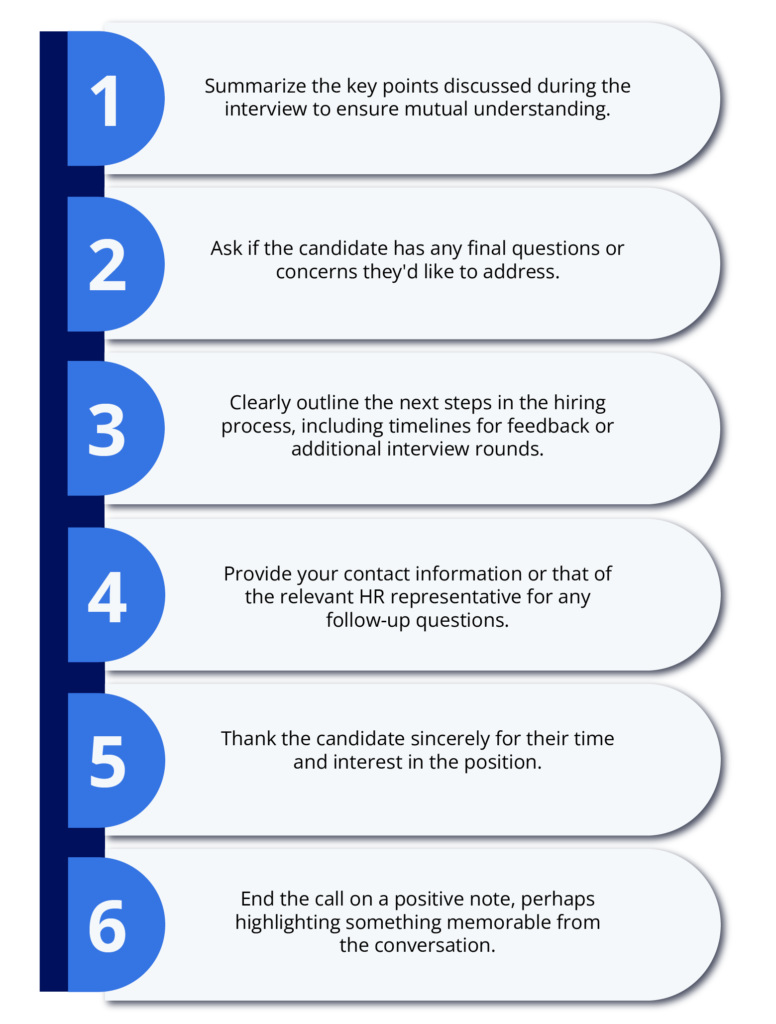
Offering a well-structured conclusion demonstrates respect for the candidate’s time and investment in the process. It also helps maintain momentum in your hiring pipeline, keeping top talent engaged and interested in your opportunity.
Tip 7: Follow Up with Feedback
The interview process doesn’t end when you hang up the video call.
Timely and thoughtful follow-up is crucial for maintaining candidate engagement and showcasing your company’s professionalism. This step is especially important in remote hiring, where personal connections can be harder to establish.
Here’s how to effectively follow up after a remote interview:
- Send a prompt follow-up email within 24 hours of the interview, thanking the candidate for their time.
- Provide a brief recap of key discussion points to reinforce your attentiveness.
- Clearly restate the next steps in the hiring process and when the candidate can expect to hear back.
- If possible, offer constructive feedback on the candidate’s performance, highlighting strengths and areas for improvement.
- Consider requesting feedback on the interview process to continuously refine your remote hiring practices.
- Keep candidates informed about their status, even if you’re still in the decision-making process.
- If a candidate isn’t selected, provide courteous and constructive feedback to maintain a positive relationship.
Final Thoughts
Remote interviews demand a refined approach to attract top global talent. The seven tips outlined here provide a foundation for effective remote hiring, helping you connect with candidates and highlight your company’s strengths.
Informed decision-making is crucial when hiring remotely. Each interview interaction offers insights into a candidate’s skills, adaptability, and cultural fit.
Always look beyond technical skills – focus on finding individuals who will thrive in a virtual environment and contribute to your company’s goals.
If you want to simplify your remote hiring process, CloudTask’s Marketplace makes it easier than ever.
Our platform offers instant access to pre-vetted sales talent, particularly from Latin America. You can browse through detailed candidate profiles, complete with video introductions, in just a few clicks.
Ready to find your next top performer? Visit CloudTask Marketplace and start exploring our pool of qualified remote candidates.