Articles
The Ultimate 2024 Guide to Use AI in B2B Sales: Transforming Success
Amir ReiterJuly 30, 2024

Artificial Intelligence (AI) has transformed B2B sales, changing how businesses approach lead generation, customer engagement, and sales forecasting.
In 2024, the adoption of AI in B2B sales strategies has become more prevalent than ever before, with B2B companies leveraging AI technologies to gain a significant competitive advantage.
However, many sales teams struggle to effectively integrate AI into their processes, often lacking the knowledge and resources needed to harness its full potential.
Without a clear roadmap and best practices, businesses risk investing in the wrong tools, failing to achieve the desired results, and falling behind their competitors.
In this comprehensive guide, we aim to tackle these challenges head-on by providing you with the knowledge and strategies necessary to successfully integrate AI into your B2B sales process and transform your sales success in 2024 and beyond.
Chapter 1: Understanding AI in B2B Sales
Artificial Intelligence, or AI, refers to the development of computer systems that can perform tasks typically requiring human intelligence, such as learning, problem-solving, and decision-making.
In the context of B2B sales, AI encompasses a range of technologies and applications designed to enhance sales processes, improve customer interactions, and drive revenue growth.
Recent advancements in machine learning, natural language processing, and predictive analytics have propelled AI to the forefront of B2B sales strategies.
Key AI technologies driving this transformation include:
- Machine Learning: Algorithms that learn from data to identify patterns, make predictions, and improve performance over time.
- Natural Language Processing (NLP): Enables computers to understand, interpret, and generate human language, facilitating seamless interactions between salespeople and customers.
- Predictive Analytics: Utilizes historical data, machine learning, and statistical algorithms to predict future outcomes, such as customer behavior and sales trends.
- Conversational AI: Chatbots and virtual assistants that engage with customers, answer questions, and provide support, freeing up salespeople to focus on high-value tasks.
- Computer Vision: Analyzes visual data, such as images and videos, to extract insights and enhance customer understanding.
A Salesforce survey found that high-performing sales teams are 4.9 times more likely to use AI than underperforming teams.
Chapter 2: Benefits of AI in B2B Sales
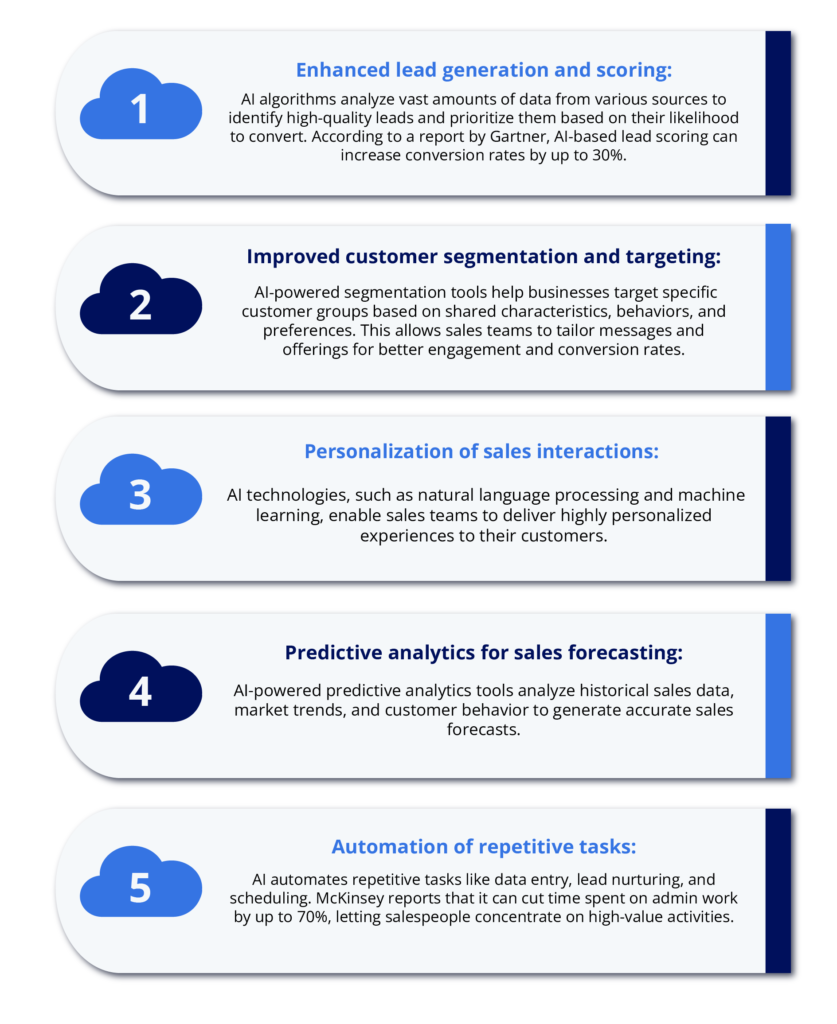
Artificial Intelligence benefits B2B sales teams by enabling them to work smarter, faster, and more efficiently.
According to a study by Harvard Business Review, companies using AI for sales increased their leads by 50% and reduced call time by 60-70%.
Let’s explore some of the key benefits of AI in B2B sales:
Chapter 3: AI Tools and Platforms for B2B Sales
The market for AI-powered sales tools is growing quickly and offers a wide range of solutions for different aspects of the B2B sales process.
These tools leverage AI to streamline workflows, automate tasks, and offer valuable insights to sales teams.
Let’s take a closer look at some of the popular AI tools in sales:
- CRM systems with AI capabilities: Many leading Customer Relationship Management (CRM) systems now incorporate AI technologies to enhance their functionality and provide more intelligent insights. Examples include HubSpot, which offers predictive analytics, lead scoring, and automated workflows, and Microsoft Dynamics 365, which utilizes AI for customer segmentation, sentiment analysis, and sales forecasting.
- AI-powered sales assistants and chatbots: Conversational AI-powered sales assistants and chatbots can handle a variety of customer interactions, from answering basic inquiries to providing personalized recommendations.
- Predictive analytics platforms: Predictive analytics platforms utilize AI algorithms to analyze vast amounts of data and generate accurate sales forecasts, identify high-value opportunities, and optimize pricing strategies.
- AI-driven email marketing tools: AI-powered email marketing tools help sales teams create personalized, engaging content and optimize their outreach efforts.
When assessing AI tools in the market, it’s crucial to consider factors like how easily they integrate with your current sales technology stack, their scalability, customization options, user-friendliness, learning curve, quality of insights and actionable recommendations, customer support and training resources, as well as pricing and return on investment.
Chapter 4: Implementing AI in Your Sales Strategy
Integrating AI into your sales strategy requires a well-planned approach to ensure successful adoption and maximum impact.
A McKinsey survey found that only 30% of companies have successfully implemented AI at scale, highlighting the importance of a structured implementation process.
Follow these steps to effectively implement AI in your sales process:
1. Assess your current sales process:
- Identify bottlenecks, inefficiencies, and areas for improvement.
- Evaluate your existing sales technology stack and data infrastructure.
- Determine your sales team’s readiness and willingness to adopt AI technologies.
2. Identify areas for AI integration:
- Pinpoint specific sales activities that can benefit from AI, such as lead generation, customer segmentation, or sales forecasting.
- Prioritize AI use cases based on potential impact and alignment with business goals.
- Define clear objectives and key performance indicators (KPIs) for each AI initiative.
3. Choose the right AI tools and platforms:
- Research and compare AI solutions that address your identified use cases.
- Evaluate tools based on factors such as ease of integration, scalability, and user-friendliness.
- Consider the vendor’s industry expertise, customer support, and training resources.
- Conduct pilot projects or proof-of-concept tests to validate the effectiveness of selected tools.
Best practices for AI implementation:
- Ensure data quality and consistency across all systems and sources.
- Provide comprehensive training and support to help sales teams adopt AI technologies.
- Establish a governance framework to manage AI-related risks and ensure ethical use of data.
- Continuously monitor and optimize AI performance based on feedback and results.
Overcoming common challenges and pitfalls:
- Address data privacy and security concerns by implementing robust data protection measures.
- Manage resistance to change by communicating the benefits of AI and involving sales teams in the implementation process.
- Mitigate the risk of AI bias by regularly auditing algorithms and ensuring diverse training data.
- Avoid over-reliance on AI by maintaining a balance between human expertise and machine intelligence.
- Plan for scalability and future-proofing by selecting AI solutions that can grow with your business.
Chapter 5: The Future of AI in B2B Sales
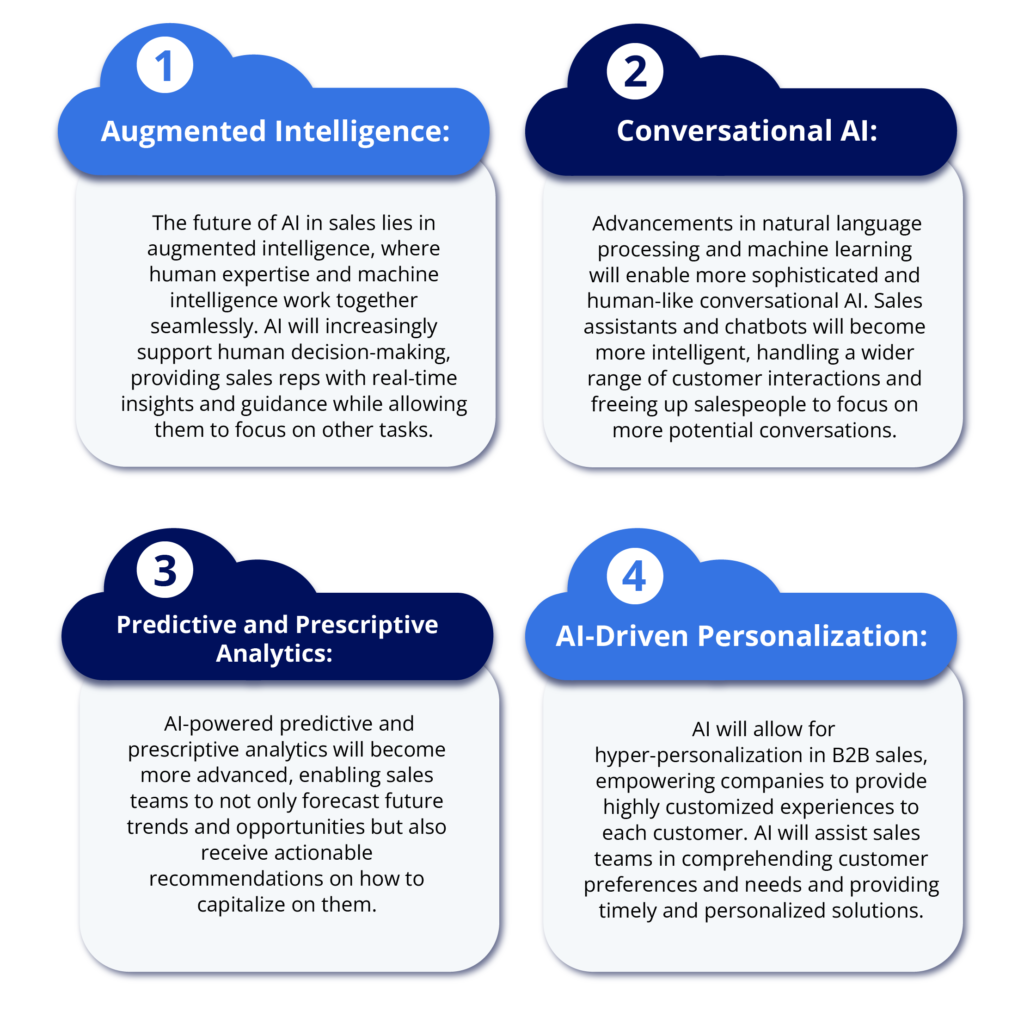
Emerging AI trends will transform sales, unlocking new opportunities to enhance customer experiences and drive revenue growth.
Let’s explore some of the key trends shaping the future of AI in B2B sales:
Final Thoughts
Choosing the right AI tools, platforms, and partners is essential to ensure a successful implementation and maximize the transformative potential of AI in your sales process.
It’s important to thoroughly evaluate your options, consider your specific business needs and goals, and seek out experienced professionals who can guide you through the adoption process.
If you want to enhance your B2B sales using AI, you should check out the CloudTask Marketplace.
Our platform offers a carefully selected group of high-performing sales agencies that specialize in AI integration. They have a proven history of assisting businesses like yours in effectively incorporating AI into their sales procedures.