
Last updated: August 6, 2026
The Short Answer
Most LATAM hires that do not stick were not lost because of geography, culture, or talent quality. They were lost for the same reasons hires are lost anywhere: pay that drifted out of band, a manager who stopped checking in, and no visible path forward. Two things make it worse across a border. Salaries paid in dollars quietly lose value against a rising local currency, and contractor-first arrangements give a good hire no reason to stay when someone else calls.
Re-hiring does not fix any of that. It resets the clock and pays the ramp cost again.
If you are building a team now, you can browse pre-vetted LATAM talent and skip the sourcing grind. The rest of this guide is about keeping the person once you have them.
The Misdiagnosis: You Probably Do Not Have a LATAM Problem
Here is the pattern. A founder hires an SDR or a CSM in Bogota or Guadalajara. Month four, the person resigns. The founder concludes that remote LATAM hiring is unreliable, and either goes back to the market for a replacement or gives up on the region entirely.
The conclusion does not follow from the evidence. One departure is not a regional trend, and the reasons people leave are well documented and mostly mundane.
Key point: If you would not blame "the US" for a US hire quitting in month four, do not blame "LATAM" for a LATAM hire quitting in month four. Diagnose the actual cause, or you will reproduce it with the replacement.
What Actually Drives People Out
Gallup surveyed 717 US adults who had voluntarily left an employer in the previous year. The headline finding: 42% of voluntary leavers said their manager or organization could have done something to keep them. Not a better market. Not a bigger offer elsewhere. Something their own employer could have done and did not.
Among those preventable departures, the reasons cluster:
- Compensation and benefits: 30%
- Manager interactions: 21%
- Organizational issues: 13%
- Career advancement: 11%
- Staffing and workload: 9%
The same research found that 45% of people who quit had no conversation with a manager or leader about their job satisfaction, performance, or future with the company in the three months before they resigned. Nobody asked. Then they left.
None of these causes are specific to Latin America. All of them are easier to let slide when the person works in another country and you only see them on a call.
What it costs to get this wrong
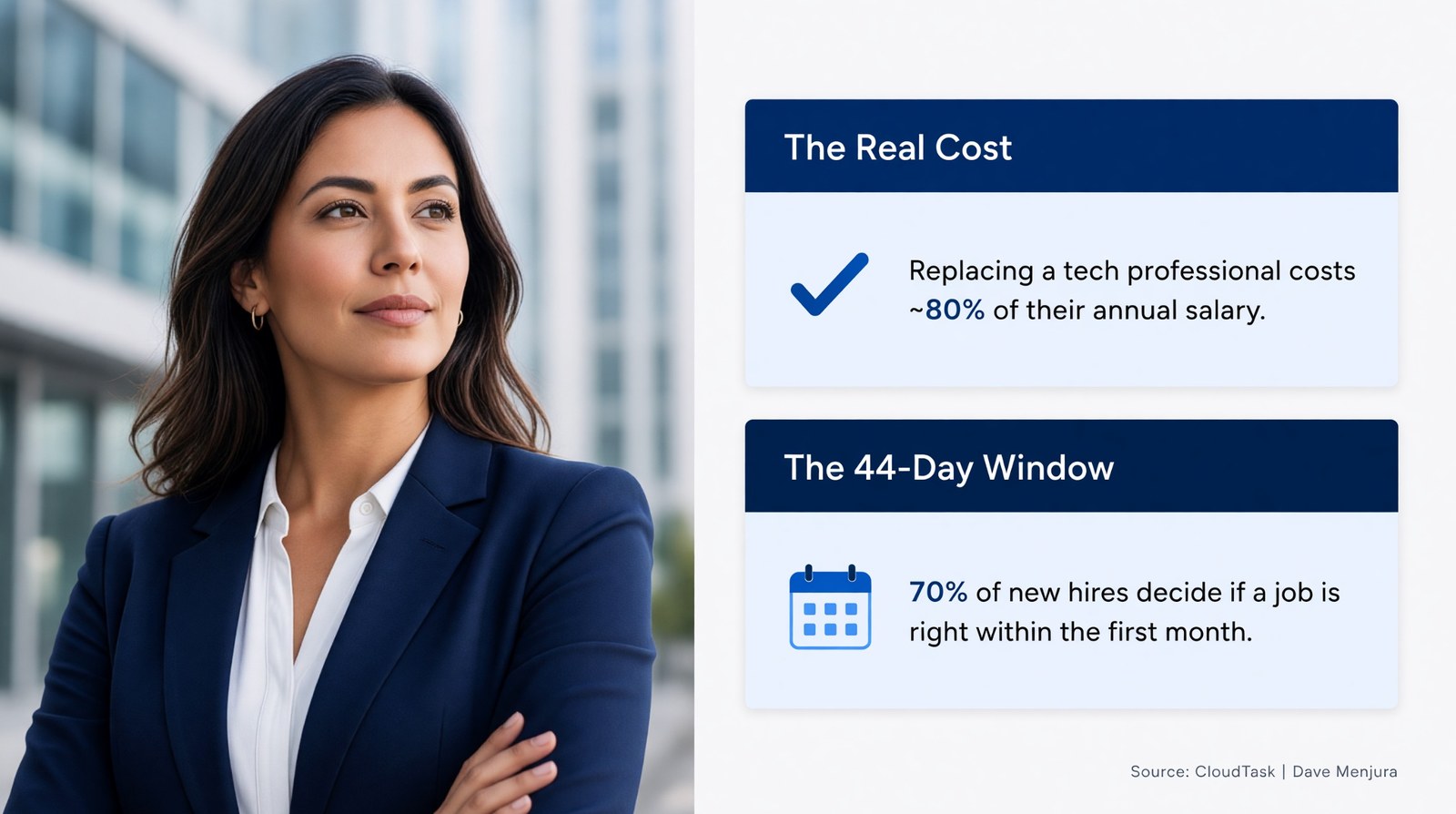
Gallup puts the replacement cost of a technical professional at about 80% of their salary, and roughly 200% for leaders and managers. On a $3,000 per month CSM, a single avoidable exit is close to $29,000 in replacement cost before you count the pipeline that went cold while the seat was empty.
That is the arithmetic that makes "just hire someone else" the expensive option.
You Have About 44 Days
The window for keeping someone is much shorter than most founders assume.
BambooHR surveyed 1,565 US full-time workers and found that companies have on average 44 days to influence a new hire's long-term retention. Seventy percent of new hires decide whether a job is right for them within the first month. Twenty-nine percent decide within the first week. Forty-four percent report second thoughts about accepting the offer within their first week.
So by the time a resignation lands in month four, the decision was very likely made in month one. The two months in between were notice, job searching, and disengagement you did not see.
Key point: A month-four resignation is a week-two problem you found out about late. Fix onboarding and early manager contact, not your sourcing.
The Two Failure Modes That Are Specific to Hiring Across a Border
Everything above applies anywhere. These two do not.
1. Your dollar salary is shrinking without you touching it
You pay in dollars. Your hire pays rent in pesos. When the dollar weakens against their currency, their real income falls and you never see it in your payroll.
This stopped being theoretical in 2026. Year to date through 6 August 2026, the Colombian peso is up about 18% against the dollar, the Brazilian real about 7%, and the Mexican peso about 4%. Colombia's official rate moved from 3,757 pesos per dollar at the end of 2025 to 3,179.
Run that through a real salary. A hire in Bogota on $2,000 per month was taking home roughly 7.5 million pesos in January. That same $2,000 is now worth about 6.4 million. Their pay did not change. Their purchasing power fell by more than a million pesos a month while you were not looking.
Now imagine that person gets a call from another company offering $2,300. To them it is not a 15% raise, it is getting back to where they started. To you it looks like disloyalty over a modest number.
For the full breakdown of what LATAM hiring actually costs and how currency is reshaping salary bands, see our guide to the cost of hiring employees in Latin America.
2. Contractor-first structures build no reason to stay
Paying a contractor directly is the cheapest way to start and the easiest way to lose someone. No benefits, no statutory protections, no tenure, no accrued anything. The switching cost for your hire is close to zero, because there is nothing to switch away from.
It also carries misclassification risk if the person works full-time hours under your direction, but the retention cost usually shows up first.
An employer of record or a staffing and recruiting partner changes the math. The person gets benefits, statutory compliance, and the sense that they hold a real job rather than an invoice relationship. See how the process works if you want the mechanics.
What To Do Instead
Six things, in rough order of how much they change the outcome.
- Review compensation against local purchasing power twice a year, not annually. Check the exchange rate, not just the dollar figure. A hire whose real pay dropped 15% is already listening to recruiters.
- Put a recurring 1:1 on the calendar and keep it. Gallup's 45% figure is the cheapest problem on this list to solve. Ask about satisfaction, performance, and where they want to go. Ask before month three.
- Treat the first 44 days as the retention project. Structured onboarding, clear expectations, and early feedback on their first contributions. This is the window where the decision gets made.
- Give the role a visible next step. Career advancement was 11% of preventable exits. "SDR forever" is not a career. Name what comes after.
- Hire through a structure that creates tenure. Benefits and compliance are retention mechanics, not just legal hygiene.
- Pay in the band that retains, not the band that closes. The cheapest quote churns. A hire who leaves at month six costs more than the savings.
How To Tell If It Is Working
Pick one number and watch it: the share of hires still in the role at 90 days. It is early enough to be actionable and late enough to be meaningful.
For reference, 85% of CloudTask placements are still in the role past 90 days. We hold that number by matching candidates to the compensation band that keeps them, using a salary and experience dataset built from more than 2,000 placements across Latin America and kept current against exchange rates.
Every placement also comes with a replacement guarantee. If someone leaves, we replace them at no extra cost. That is the backstop, not the strategy. The strategy is not needing it.
Key Takeaways
- Most early exits are preventable and ordinary. Gallup found 42% of voluntary leavers said their employer could have kept them.
- Compensation (30%) and manager interactions (21%) are the two biggest preventable causes.
- 45% of leavers had no conversation about satisfaction, performance, or future in their final three months.
- The retention decision is made early. Companies have roughly 44 days of influence, and 70% of hires decide within the first month.
- Dollar-denominated salaries lose real value when local currencies appreciate. In 2026 that hit Colombia hardest, at about 18% year to date.
- Contractor-first structures give a good hire nothing to stay for.
- Track 90-day retention. Re-hiring is the most expensive way to respond to a problem you can usually fix for the price of a recurring meeting.
Frequently Asked Questions
Why do LATAM hires leave after a few months?
Usually for the same reasons hires leave anywhere: pay that has drifted out of market band, no regular contact with a manager, and no visible career path. Gallup found 42% of voluntary leavers believed their employer could have prevented their exit. Across a border, two additional causes apply: dollar salaries losing value against a strengthening local currency, and contractor arrangements that create no tenure.
Is turnover higher in Latin America than in the US?
Not inherently. Turnover tracks management practice, compensation, and role design far more than geography. The cross-border factors that do matter, currency movement and employment structure, are both things you control.
How soon should I worry about a new hire leaving?
Sooner than most managers do. BambooHR found 70% of new hires decide whether a job suits them within the first month and 29% within the first week. If your first real check-in is at 90 days, the decision has already been made.
How often should I review a LATAM hire's salary?
At least twice a year, and always against the current exchange rate rather than the dollar figure alone. A 15% currency move is a 15% pay cut in the only currency your hire actually spends.
Does paying more actually reduce turnover?
Compensation was the single largest cited cause of preventable exits at 30%, so it matters. But manager interactions (21%) and career advancement (11%) together account for more. Pay fairly, then do the management work. Money alone does not retain someone nobody talks to.
Is a contractor or an EOR better for retention?
An employer of record or staffing and recruiting partner is better for retention. Contractors have no benefits, no statutory protections, and no accrued tenure, so the cost of leaving you is close to zero. Contractors suit project work, not embedded team members.
What retention rate should I expect?
Measure it yourself at 90 days before benchmarking against anyone. As a reference point, 85% of CloudTask placements are still in the role past 90 days. Be skeptical of vendors quoting very high multi-year retention without saying how it was measured.
Build a Team That Stays
Re-hiring every few months is not a talent-market problem. It is a compensation, management, and structure problem wearing a talent-market costume.
CloudTask gives you access to pre-vetted GTM talent in 48 hours, with video profiles so you can judge communication and fit before the first call. We act as vendor of record across multiple LATAM countries, handling payroll, benefits, and compliance, and we match on compensation bands built to retain rather than to close.
Start here. Browse pre-vetted talent, or read why companies hire in LATAM before you commit.
Author
Dave Menjura, CloudTask. Helping US B2B companies build and keep high-performing go-to-market teams in Latin America.