Last updated: August 6, 2026
What Is the Cost to Hire Employees in Latin America? (The Short Answer)
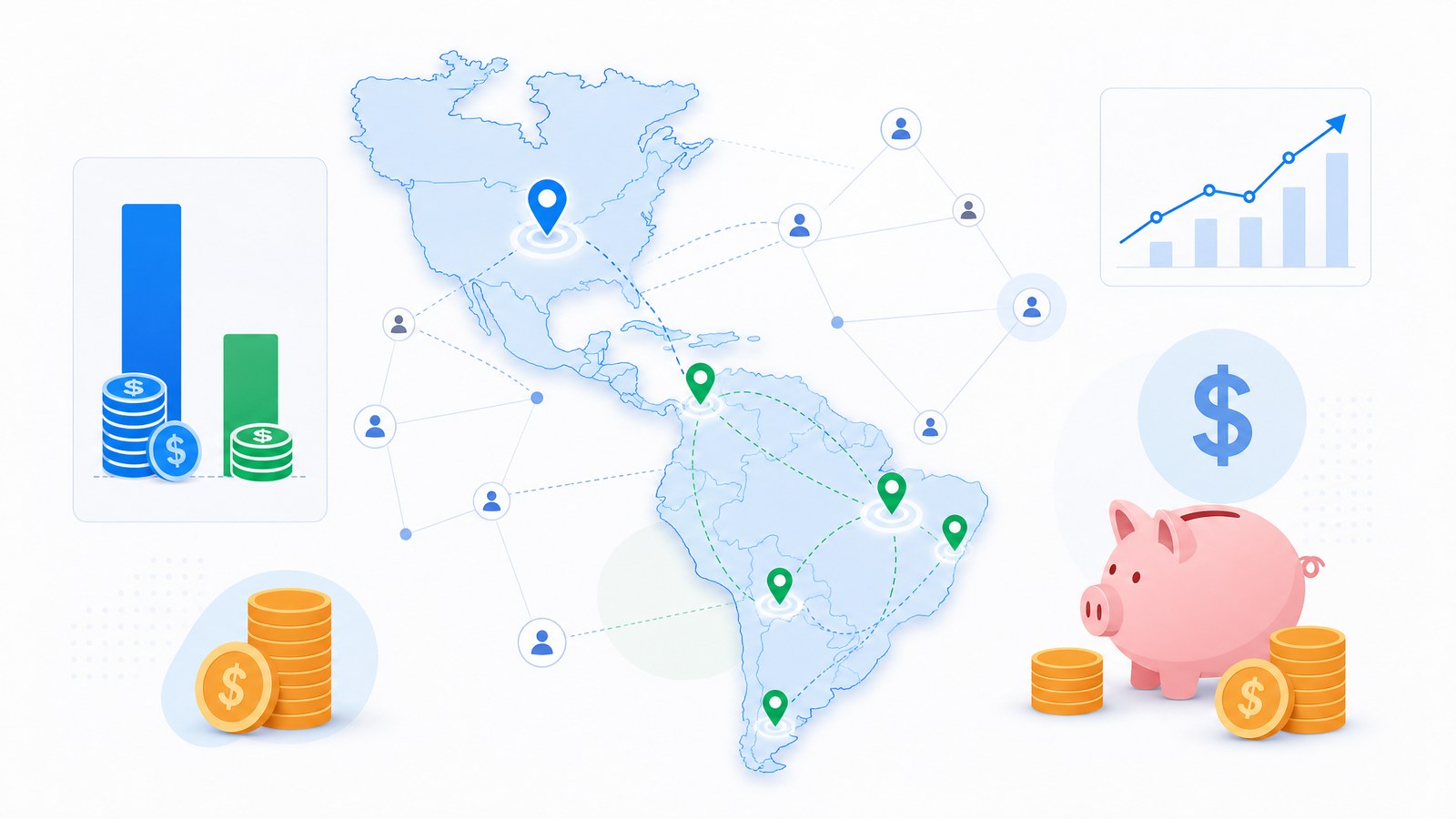
Hiring a full-time employee in Latin America costs $1,200 to $7,500 per month in base salary, plus $400 to $800 per month for an EOR or staffing fee, plus $500 to $1,500 in one-time setup. Total savings vs an equivalent US hire: 30 to 65%. Those ranges are higher than most 2025 guides because of 2026 currency appreciation, which is concentrated in Colombia: the peso there is up about 18% against the dollar year to date, versus about 7% in Brazil and about 4% in Mexico.
That is the complete budget picture. The rest of this guide breaks down each component so you can plan role by role, including why budgeting on last year's numbers will cost you your best hires.
If you need GTM talent fast, you can access pre-vetted LATAM talent through a staffing and recruiting partner and skip the sourcing grind.
Why US Companies Look to Latin America
US labor is expensive. It is also slow to hire. The average sales hire in the US takes weeks to close, and the fully loaded cost runs well into six figures annually.
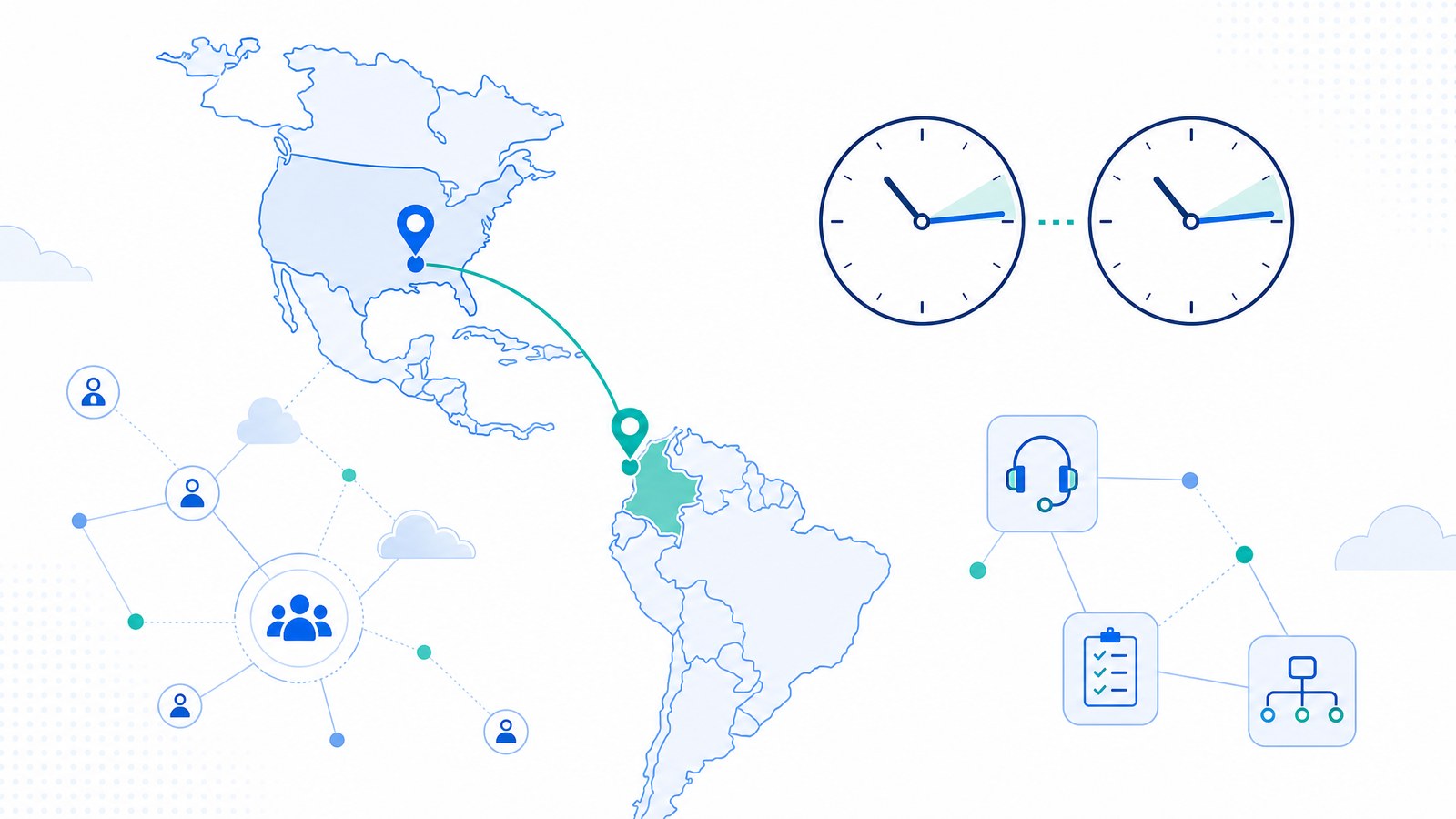
LATAM offers a different equation. You get comparable skills at a lower price point with timezone alignment. Nearshore hiring means your LATAM team is 1 to 3 hours from US time zones. You can run standups and live calls without the overnight scheduling pain of offshore markets in Asia or Eastern Europe.
That overlap drives retention and productivity. When your SDRs and CSMs work the same hours as your US customers, they close deals faster and stay longer. Learn more about why companies hire in LATAM.
The True Cost of a US Hire (Your Baseline)
Before you compare LATAM costs, you need the real baseline: what a US hire actually costs you beyond the offer letter.
According to the Bureau of Labor Statistics, total US employer compensation costs for private industry workers averaged $46.60 per hour worked in March 2026, in the release published 12 June 2026. Wages and salaries averaged $32.60 per hour worked (69.9%) and benefit costs $14.01 (30.1%), split across insurance, retirement, legally required payroll taxes, paid leave, and supplemental pay.
Two of those lines, paid leave and supplemental pay, are already inside a salaried base, so for a salaried hire budget the narrower load: insurance, retirement, and legally required payroll taxes come to about 26% of wages. For every $100,000 in base salary that is roughly $26,000 more, about $126,000 all in, and a $120,000 SDR in San Francisco costs you closer to $152,000. The full BLS split, which measures cost per hour worked and counts paid leave as a benefit, puts the load nearer 43%. Treat that as the outer bound rather than a payroll-exact figure.
That fully loaded figure, not the base salary, is what you should compare against when evaluating LATAM hires.
The Components of LATAM Hiring Costs
A LATAM hire's total cost has the same layers as a US hire, but the numbers are smaller.
Base Salary
This is the monthly rate you negotiate. It varies by role and experience. Expect $1,200 to $2,500 per month for support roles and $3,000 to $7,500 per month for senior GTM and technical professionals. These figures sit above what most 2025 guides published, driven by currency appreciation that is concentrated in Colombia rather than spread across the region (more on that below).
Employer Contributions and Benefits
Most LATAM countries require employer contributions for social security and healthcare, and most mandate a statutory annual bonus. Per the Inter-American Development Bank's analysis of statutory labor costs in Latin America, that bonus is set in days of wage and varies far more than any single regional figure suggests. Peru and Guatemala mandate 60 days, Colombia, Brazil, and Argentina 30 days (worth about 8% of annual wage), El Salvador 19 days, and Mexico 15 days. Chile mandates none. Mexican law requires the aguinaldo be paid before 20 December.
If you work through an EOR or staffing and recruiting partner, you pay a flat monthly fee instead of managing these contributions directly. That fee typically runs $400 to $800 per month per employee and covers payroll, benefits, and compliance.
One-Time Setup
Budget $500 to $1,500 for a laptop and software licenses. Some companies add a home-office equipment stipend.
Why LATAM Salaries Are Rising in 2026: The Currency Factor
If you budgeted your LATAM hires on 2025 numbers, your budget is already stale. The reason is the dollar.
In 2026, the US dollar has weakened against the region's largest currencies, but the move is concentrated rather than region-wide. Year to date from the 31 December 2025 close through 6 August 2026, the Colombian peso is up about 18% against the dollar, the Brazilian real about 7%, and the Mexican peso about 4%. Colombia's official TRM stands at 3,179.40 pesos per dollar, down from 3,757.08 at the end of 2025, and Bloomberg calls the peso the world's best-performing currency of 2026. Argentina ran the other way: its peso depreciated against the dollar through 2026.
Here is what that means for your budget. Your LATAM hire pays rent and groceries in pesos or reales, but you pay them in dollars, so a falling dollar converts to less local currency for the same offer. Since the end of 2025 the dollar buys about 15% fewer Colombian pesos, about 7% fewer Brazilian reais, and about 4% fewer Mexican pesos. A $2,000 per month offer in Bogota that converted to 7.5 million pesos at the end of 2025 converts to about 6.4 million today. Holding that hire's pay flat in pesos now costs about $2,360 a month.
Two things follow:
- New-hire market rates are moving up. USD-denominated offers that cleared the market in 2025 are getting declined in 2026.
- Existing hires need compensation reviews. If you have not adjusted pay for currency movement, your best people are quietly interviewing. Losing a ramped hire over a $200 adjustment is the most expensive mistake in nearshore hiring.
The ranges below reflect 2026 market rates, not recycled 2025 data.
Salary Ranges by Role in Latin America
The ranges below are typical monthly base pay for mid-level professionals in LATAM, compared with US equivalents. These benchmarks come from CloudTask's placement dataset, built from 2,000+ SaaS placements across the region, and reflect 2026 currency-adjusted rates. Actual rates vary by market and hiring context.
- Virtual Assistant. LATAM $1,200 to $2,000 per month, against $3,500 to $5,000 in the US. Typical savings 55 to 65%.
- Executive Assistant. LATAM $1,400 to $2,400 per month, against $4,500 to $6,500 in the US. Typical savings 60 to 70%.
- Customer Support Rep. LATAM $1,300 to $2,200 per month, against $3,800 to $5,500 in the US. Typical savings 55 to 65%.
- Customer Success Manager. LATAM $2,500 to $4,500 per month, against $6,500 to $9,500 in the US. Typical savings 50 to 60%.
- SDR / BDR. LATAM $2,000 to $3,800 per month, against $5,500 to $8,000 in the US. Typical savings 50 to 60%.
- Account Manager. LATAM $2,800 to $5,000 per month, against $7,000 to $10,000 in the US. Typical savings 50 to 60%.
- Marketing Specialist. LATAM $2,200 to $4,000 per month, against $5,500 to $8,500 in the US. Typical savings 50 to 60%.
- Bookkeeper. LATAM $1,500 to $2,800 per month, against $4,500 to $6,500 in the US. Typical savings 55 to 60%.
- Software Developer. LATAM $4,500 to $7,500 per month, against $10,000 to $15,000 in the US. Typical savings 45 to 55%.
Senior and specialized engineers (project leads, ML infrastructure, architecture) run above these ranges, commonly $7,500 to $10,000 per month for US-facing remote roles.
One note on these ranges: they reflect compensation bands that retain talent past year one. You can find cheaper quotes, especially on freelance marketplaces. Those hires churn, and a hire who leaves at month six costs more than the savings. With 2026 currency appreciation squeezing local purchasing power, paying at the bottom of the market is riskier than it has ever been.
For the cost of a specific role and seniority, see how CloudTask pricing works: the all-in rate for your role is quoted before you interview anyone. If you are building a sales team, you can hire remote SDRs through CloudTask.
Cost by Country: Where You Hire Changes the Price
Your choice of country affects both base pay and employer burden.
Key point: Labor tax and contribution burdens in LATAM are lower than the OECD norm, but they are nowhere near zero, and headline tax comparisons hide them.
The OECD's Taxing Wages 2026 puts Colombia's tax wedge at 0.0%, the lowest of the 38 member countries against a 35.1% average. That zero is a classification artifact, not an absence of cost. A Colombian worker at the average wage owed no personal income tax in 2025, and their pension, health, and employment-risk contributions are treated as non-tax compulsory payments and excluded from the wedge by construction. Add those back and Colombia's compulsory payment wedge, which counts employee and employer payments together as a share of total labor cost, rises to 18.2%. That is the largest such adjustment in the OECD, and it still sits below Chile's 23.0% and Costa Rica's 27.7%, at about half the OECD average.
Mexico's 2026 minimum wage is 315.04 pesos per day, which CONASAMI converts to 9,582.47 pesos per month, or about $556 at the Banco de Mexico FIX rate of 17.2317 pesos per dollar on 6 August 2026. In the northern border free zone the floor is higher, 440.87 pesos per day or about $778 per month. Colombia's 2026 minimum wage is 1,750,905 pesos per month, about $551 at the official TRM of 3,179.40 on the same date. Colombian employers also owe a transport allowance of 249,095 pesos, but only for workers earning up to two minimum wages, about $1,101 per month, so it does not apply to skilled GTM hires. Those hires earn well above all of these floors.
Here is how a few markets compare:
- Colombia has strong English proficiency in major cities. Employer contributions run about 16.5% of wages for employees earning under ten minimum wages, roughly $5,500 a month, at a company that qualifies for the health, SENA, and ICBF exemptions, and about 30% above that threshold or at an employer that does not qualify, before severance, prima, and leave accruals.
- Mexico has a similar wage floor and a large bilingual talent pool in Guadalajara and Mexico City.
- Argentina has historically strong developer talent, though currency volatility adds complexity.
- Central America and the Caribbean have lower base rates for support and administrative staff.
How Much You Save vs a US Hire
Let's put the numbers side by side for a sample role: a mid-level Customer Success Manager.
- Base salary. $96,000 in the US ($8,000 per month), against $36,000 in LATAM ($3,000 per month).
- Employer benefits and taxes. About $25,200 in the US, roughly 26% of base. In LATAM these are billed through the staffing rate.
- Staffing or EOR fee. None for a US hire. $7,200 in LATAM ($600 per month).
- One-time setup. $1,500 in the US, $1,200 in LATAM.
- Total year-one cost: $122,700 in the US, against $44,400 in LATAM.
- Savings: about 64%.
Your actual savings depend on the role and hiring market. Expect 30 to 65%, with the higher end for support roles and the lower end for senior engineering.
For a detailed breakdown, see how CloudTask stacks up compared with US direct hiring.
Key point: For the cost of one fully loaded US hire, you can often bring on two experienced LATAM professionals and still have budget left over.
How You Hire Changes the Cost: Contractor, EOR, or Staffing Partner
Two decisions affect what you pay: whether you go compliant (EOR or staffing partner) or lean (contractor), and whether you handle sourcing yourself or outsource it.
Pay a Contractor Directly
You negotiate a rate, pay invoices monthly, and avoid employer contributions. This is the lowest administrative cost. However, if the contractor works full-time hours on your direction, you risk misclassification under local labor law.
Use an Employer of Record (EOR)
An EOR hires the worker on your behalf and handles payroll and compliance. You pay a monthly per-employee fee ($400 to $800 per month is typical). This model is fully compliant but adds a recurring cost. An EOR does not source talent for you. You still recruit on your own.
Use a Staffing and Recruiting Company
A staffing and recruiting company combines talent sourcing, vetting, payroll, benefits, and labor-law compliance in one monthly fee. It is not an outsourced agency, which employs the reps and sells you their output as a service, and it is not a job board, which sells you access to unvetted applicants. You hire the person and they join your team; the staffing partner handles everything around the hire.
CloudTask is a staffing and recruiting company. You choose from pre-vetted candidates with video profiles, and CloudTask operates as vendor of record across multiple LATAM countries, handling payroll, benefits, and compliance for every placement. See how the process works.
Key point: If you need a full-time, embedded team member, an EOR or staffing and recruiting company keeps you compliant. If you need project-based help, a contractor may fit. If you also need sourcing done for you, a staffing and recruiting company is the only one of the three that covers it.
For a deeper look at employment rules, read our guide to Latin American labor laws.
The Cost Everyone Forgets: Turnover
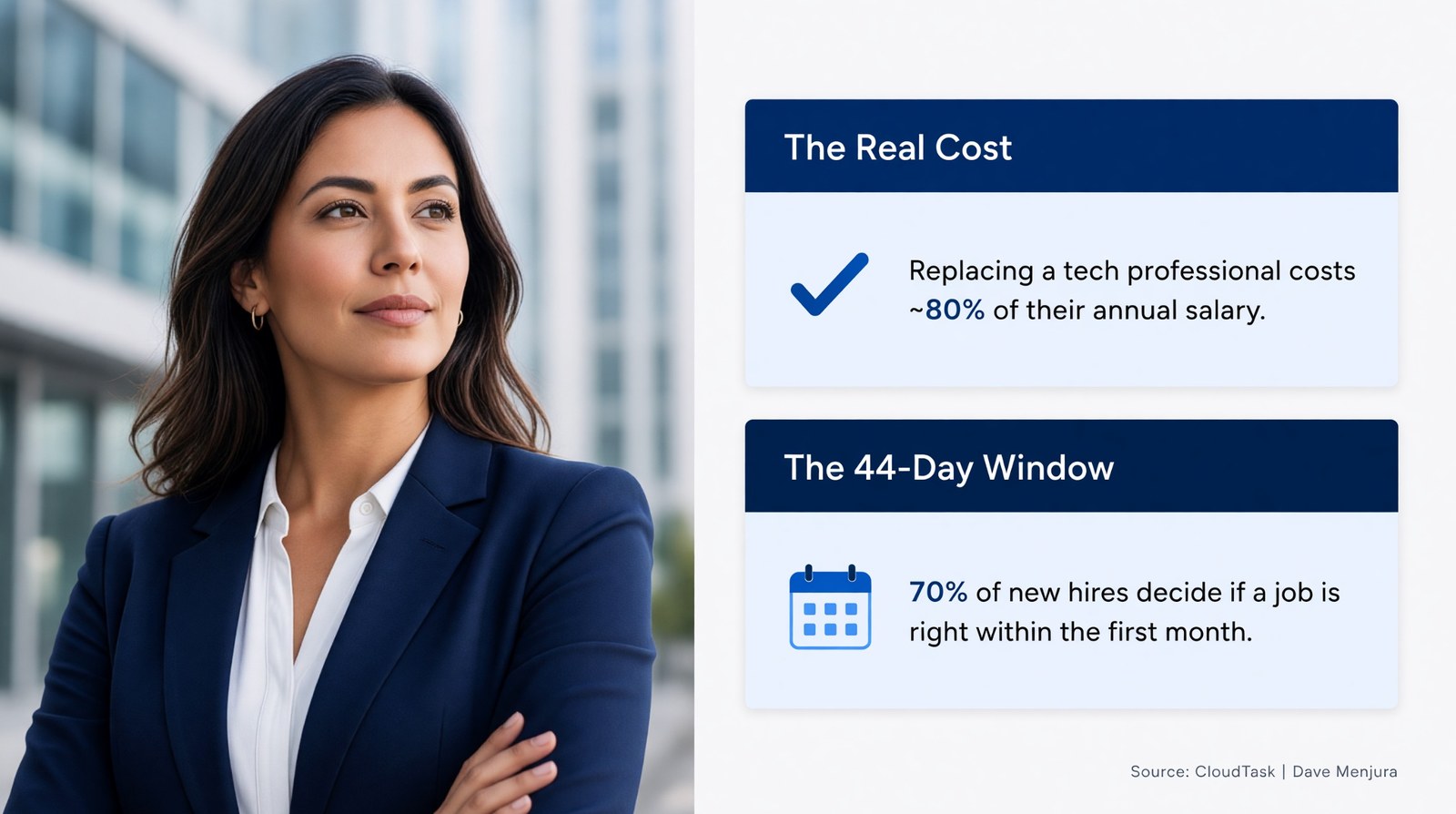
A cheap hire who leaves after six months is an expensive hire. You lose the ramp time and institutional knowledge. Then you pay to recruit again.
Retention is part of true cost. And retention depends on matching pay to the right local band. Underpay and your hire gets poached. Overpay and your margins erode. In 2026, currency movement makes this harder: a salary that sat in the right band at the start of this year may now be a silent pay cut for your hire.
CloudTask solves this with data. We maintain a salary and experience dataset built from 2,000+ placements across Latin America, updated against current exchange rates. We match candidates at the compensation band that keeps them from leaving. The result: 85% of CloudTask placements are still in the role past 90 days.
And we back every placement with a replacement guarantee. If someone leaves, we replace them at no extra cost.
Key Takeaways
- Real cost includes base salary plus employer contributions (or an EOR fee) plus one-time setup. Do not budget on base alone.
- Base pay runs $1,200 to $7,500 per month depending on role and seniority, with specialized senior engineers above that.
- Currency moves in 2026 are concentrated, not region-wide: year to date through 6 August 2026 the Colombian peso is up about 18% against the dollar, the Brazilian real about 7%, and the Mexican peso about 4%. Budgets built on 2025 salary guides are stale, and Colombian hires most need compensation reviews.
- Savings commonly range from 30 to 65% versus a US hire. Support roles hit the higher end; senior technical roles hit the lower end.
- Colombia and Mexico offer a balanced cost-to-skill ratio, but employer burden is real rather than near zero. Colombian employer contributions run about 16.5% of wages for employees under ten minimum wages at a qualifying employer, and about 30% above that threshold or at an employer that does not qualify.
- An EOR or staffing and recruiting company adds a monthly fee but removes compliance risk. Only a staffing and recruiting company also handles sourcing.
- Retention protects your savings. Longer tenure keeps more of the cost advantage you built.
Frequently Asked Questions
How much does it cost to hire an employee in Latin America?
Most full-time LATAM professionals cost $1,200 to $7,500 per month in base pay, plus employer contributions or an EOR/staffing fee of $400 to $800 per month. One-time setup adds $500 to $1,500.
What is the cost of hiring SDRs in Latin America?
A mid-level LATAM SDR runs $2,000 to $3,800 per month in base salary, compared to $5,500 to $8,000 per month for a US equivalent. Add a staffing or EOR fee of $400 to $800 per month for a fully compliant hire, and total savings land around 50 to 60%.
Why are LATAM salaries higher in 2026 than last year?
The dollar has lost ground against the region's largest currencies since the end of 2025, though unevenly. Through 6 August 2026 the Colombian peso is up about 18% against the dollar, the Brazilian real about 7%, and the Mexican peso about 4%. Since LATAM professionals spend in local currency, USD offers have had to rise to hold the same purchasing power, substantially in Colombia and only marginally in Mexico. Guides showing 2025 ranges understate current market rates, most of all in Colombia.
Which country is cheapest to hire from in Latin America?
Central American and Caribbean countries often have the lowest base rates for support and admin roles. For GTM roles with strong English requirements, Colombia and Mexico offer the best balance of cost and quality.
How does LATAM cost compare to the US?
US companies commonly save 30 to 65% by hiring in LATAM versus domestically. The exact savings depend on role and seniority.
Do you pay benefits when hiring in LATAM?
If you hire through an EOR or staffing and recruiting company, benefits are included in your monthly fee. If you hire directly, you are responsible for statutory contributions like social security and the aguinaldo.
What is the difference between a staffing and recruiting company and an outsourced SDR agency?
An agency employs the reps and sells you their output as a service. A staffing and recruiting company like CloudTask connects you with pre-vetted professionals who join your team directly, then handles payroll, benefits, and compliance around the hire. You own the relationship and the ramp; the staffing partner removes the administrative burden.
Do you need an EOR or can you pay contractors directly?
You can pay contractors directly for project work. But if you need someone full-time and integrated into your team, an EOR or staffing and recruiting company protects you from misclassification risk under local labor law.
Ready to Build Your LATAM Team?
You now know what LATAM hiring actually costs: ongoing costs (base plus fees) and a small setup investment. You know how much you can save compared to US direct hires. And you know that retention protects those savings over time.
CloudTask gives you access to pre-vetted GTM talent in 48 hours. Every candidate has a video profile so you can evaluate communication and fit before the first call. We handle payroll, benefits, and compliance across multiple LATAM countries as your vendor of record. Every hire comes with a replacement guarantee.
Get started today. Browse pre-vetted talent and build your LATAM team.
Author
Written by Amir Reiter, Founder & CEO of CloudTask. Since 2016 CloudTask has placed more than 10,000 hires with US B2B companies like Expensify and Apollo.io.