Last updated: October 29, 2026
The Short Answer
To hire an SDR in Latin America, define the quota first, set a budget, screen candidates with a live cold-call role-play, and plan a 90-day ramp. The Bridge Group puts average SDR ramp at 3.0 months. CloudTask, a staffing and recruiting company, sends 3 to 5 screened profiles within 48 hours.
This guide walks you through each step in order. It is written for US founders and CEOs who know what an SDR does but have never hired one outside the US. If you are still deciding between a dedicated rep and an agency, read in-house SDR vs. outsourced SDR agency first.
Step 1: Define the SDR Role and Quota Before You Post the Job
The median SDR quota is 10 held Stage 0 meetings a month, according to the Bridge Group 2025 SDR Metrics Report (351 B2B companies, February 2025). Use that number as a starting point, then adjust it to your deal size and sales cycle.
Write down 4 things before you talk to a single candidate:
- Motion. Outbound, inbound follow-up, or both. Outbound reps need more call volume and thicker skin.
- Channels. Phone, email, LinkedIn. The same report shows a median of 112 total daily activities and 4.1 quality conversations a day.
- Handoff. Who takes the meeting. Bridge Group reports 1 SDR for every 2.4 AEs. If you are the only closer, your calendar is the ceiling.
- Definition of a qualified meeting. Title, company size, and the one question that must be answered before the meeting counts.
Key point: If you cannot write the meeting definition in 2 sentences, the SDR cannot hit it. Fix that before you hire.
Step 2: Build the Candidate Profile
A strong SDR profile for a US B2B company starts with conversational English on the phone, then proof of outbound volume in a past role. CloudTask screens every candidate on English, track record, and tools, and runs the screen on a live call.
The 6 skills from our original version of this guide still hold:
- Clear communication across phone, email, and LinkedIn.
- Active listening. Good SDRs hear the pain behind a brush-off.
- Research and prospecting. They can build a list and find a reason to call.
- Organization. Dozens of sequences run at once, and nothing slips.
- Resilience. Most calls end in a no. The good ones dial again.
- Tool fluency in a CRM and a sequencer.
2 more matter when you hire remote. First, time zone: CloudTask hires across 12 countries in Latin America and the Caribbean, and all of them work US business hours. Second, prior exposure to US buyers. A rep who has already called into US accounts needs less coaching on tone and objections.
Do not over-weight industry background. A rep who has run a disciplined outbound process in another vertical learns your product faster than a rep who knows your industry but has never hit a number.
What should you budget for an SDR in Latin America?
CloudTask recommends a budget of $3,000 to $4,000 a month for a career-focused LATAM SDR, as published in our August 2026 guide to LATAM SDRs and calling technology. Published ranges vary by seniority and source. Hire With Near lists $2,000 to $2,500 a month for a mid-level SDR/BDR. For comparison, the Bridge Group reports a median US SDR OTE of $80K ($55K base plus $25K variable).
CloudTask hires cost up to 75% less than an equivalent US hire.
Step 3: Decide Where to Find Candidates in Latin America
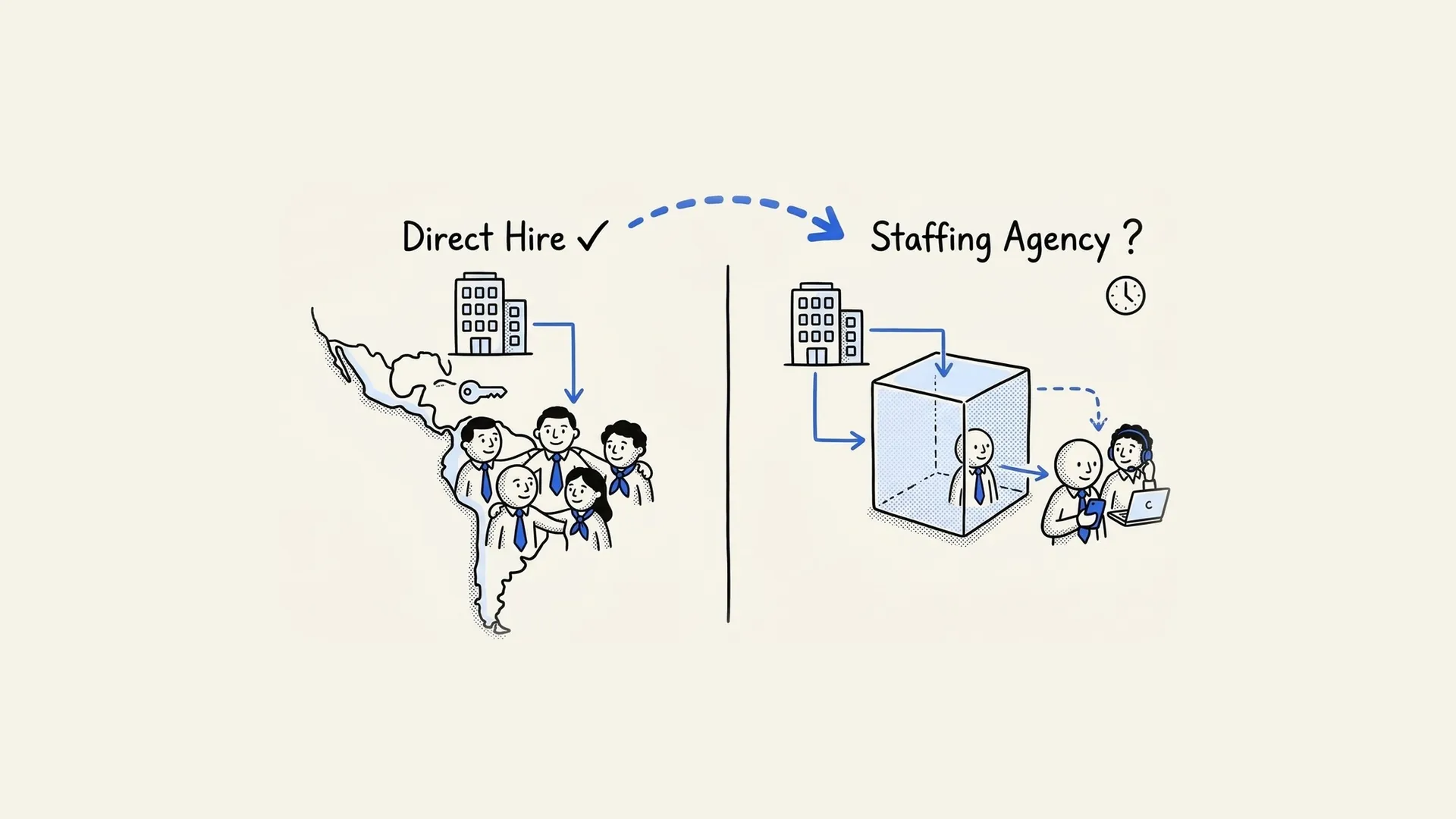
US companies find LATAM SDRs through 3 channels: posting the role and sourcing on their own, paying a recruiter a one-time placement fee, or working with a staffing company that bills one monthly rate per person. Each one shifts work and risk differently.
- On your own. You post on LinkedIn and local job boards, screen every applicant, handle contracts and payments in another country, and own the risk if the hire leaves.
- Recruiter or direct hire firm. The firm sources and screens. You pay once, the rep joins your payroll, and you handle employment from there.
- Staffing company. The firm sources, screens, and handles payments and compliance. You direct the work day to day.
Which companies help US B2B teams hire SDRs from Latin America?
Several companies place SDRs from Latin America with US B2B teams, and each publishes a different model and replacement guarantee. The table compares them on what each one states on its own site, checked on October 12, 2026.
| Company | Models | Replacement guarantee | Other published detail |
|---|---|---|---|
| CloudTask | Direct Hire, Managed Staffing | Direct Hire: 6 months, 1 replacement. Managed Staffing: 24 months, replacements not capped | 3 to 5 screened profiles within 48 hours |
| Hire With Near | Staffing, direct hire | Staffing: for the duration of the engagement. Direct hire: 180 days | Publishes salary ranges by role |
| South | Flat monthly rate per hire, headhunting | Headhunting: 120 days | "<16 Days to Hire" |
| Somewhere | Direct Hire, Talent On-Demand | Direct Hire: 6 months, 1 free replacement. Talent On-Demand: unlimited free replacements | LATAM, South Africa, Philippines |
| LatamCent | Talent as a Service, Direct Hire | 60 days | 19 days median from kickoff to accepted offer |
Ask every provider the same 3 questions: who is the contracting party, how long the guarantee lasts under the model you pick, and whether the rep works only your accounts.
Step 4: How do you interview an SDR with a cold-call role-play?
A cold-call role-play shows an SDR candidate's English, composure, and coachability in 15 minutes. A résumé tells you where someone dialed. The role-play tells you how.
Run it like this:
- Send a one-page brief 24 hours ahead. Your ICP, one customer problem, and the meeting you want booked. Nothing more.
- Play a busy US prospect for 5 minutes. Open with "I've got 30 seconds." Throw 2 objections: "We already use a vendor" and "Send me an email."
- Give one piece of feedback. Be specific: "You pitched before you asked a question."
- Run the call again. The second attempt matters more than the first. A rep who adjusts in 2 minutes will adjust in week 3.
Score each call on the same rubric so you can compare candidates:
| Criterion | What a strong answer sounds like |
|---|---|
| Opener | Names a reason for the call tied to the prospect, in under 20 seconds |
| Discovery | Asks at least one open question before pitching |
| Objection handling | Acknowledges, asks, redirects. Does not argue |
| The ask | Proposes a specific time for the meeting |
| Coachability | Applies the feedback in the second call |
| English | Clear and natural at speed, even under pressure |
Add 2 short async tasks if you want more signal: a 60-second voicemail recording and a 3-sentence cold email to the same prospect. Then ask about tools: which CRM, which sequencer, and how they built their last list.
Step 5: Set Up the SDR Tool Stack
A remote SDR stack has 5 core pieces: a CRM, a sequencing tool, a dialer with US numbers, a contact data source, and call recording. CloudTask's calling technology guide puts the calling stack at $100 to $250 per seat per month.
| Layer | Common options |
|---|---|
| CRM | HubSpot, Salesforce, Pipedrive |
| Sequencing | Outreach, Salesloft, Apollo |
| Dialer | Salesfinity, Orum, Nooks, Kixie |
| Data and enrichment | Apollo, Clay |
| Call recording and coaching | Gong |
Provision US local numbers before day one. Give the rep their own seat in your CRM. If they log activity in a system you cannot see, you cannot coach them.
Step 6: Hire With a Partner or On Your Own
CloudTask offers 2 models for SDR hires, and both are open to every role: Direct Hire, where you pay a one-time fee and the rep joins your payroll, and Managed Staffing, where you pay one all-in monthly rate. The right one depends on whether you want to run payroll and compliance in another country.
| Direct Hire | Managed Staffing | |
|---|---|---|
| Fee | 20% to 30% of first-year base salary. One time, quoted per role | One all-in monthly rate per person, with nothing added to it |
| Who pays the rep | You, on your payroll | CloudTask is the contracting party. You direct the work |
| What is included | Sourcing and screening | Worker payments, compliance and employment administration, onboarding support at day 7, 30 and 60, ongoing check-ins |
| Replacement guarantee | 6 months. 1 replacement, same job description | 24 months. Replacements not capped |
| Minimum term | None | 6-month minimum term for roles that create demand, including outbound SDRs |
Both models start with a $299 deposit per hire, not a subscription, credited toward the placement fee on Direct Hire or the first monthly payment on Managed Staffing. Pick Direct Hire if you already employ people abroad and want the rep on your own payroll. Pick Managed Staffing if you want someone else to handle payments and compliance, and a longer guarantee. Our post on direct hire vs. staffing in Latin America goes deeper.
You can also do it alone. Plan for sourcing time, a contractor or employer-of-record setup, international payments, and no replacement if the hire walks.
Step 7: What does a 90-day SDR onboarding plan look like?
The Bridge Group reports an average SDR ramp of 3.0 months in 2025, the lowest since 2010. A 90-day plan matches that benchmark, so set expectations by month instead of asking for full quota in week 2.
| Period | Focus | Target |
|---|---|---|
| Days 1 to 30 | Product, ICP, messaging, tools. Shadow calls. Start dialing in week 2 with a small list | Activity and quality conversations, not meetings |
| Days 31 to 60 | Full sequences live. Weekly call reviews | About half of the monthly meeting quota |
| Days 61 to 90 | Full territory. Rep owns their list building | Full quota by the end of month 3 |
Hold a 30-minute call review every week. Pick 2 recorded calls, one good and one bad. On Managed Staffing, CloudTask adds onboarding check-ins at day 7, 30 and 60.
Key point: Lock the ICP and the meeting definition in month 1. If they change in month 2, the 90-day clock starts over.
Step 8: Measure SDR Performance
SDR performance comes down to held meetings against quota, quality conversations per day, and pipeline created. The Bridge Group 2025 report gives you US benchmarks for all 3, and only 60% of reps hit quota, the lowest on record.
- Meetings held vs. quota. Benchmark: 10 Stage 0 meetings a month (global median).
- Quality conversations. Benchmark: 4.1 a day.
- Pipeline per SDR. Benchmark: $3.78M per SDR, up from $2.83M in 2022.
- Retention. Bridge Group puts median annual SDR attrition at 40% and average tenure at 1.9 years. At CloudTask, 85% of hires are still in seat past 90 days.
Review activity weekly and outcomes monthly. If activity is high and meetings are low, look at the list and the message before you look at the rep.
Key Takeaways
- Define the meeting and the quota before you post the role. The Bridge Group median is 10 held Stage 0 meetings a month.
- Screen on English, outbound track record, and tools, and use a live cold-call role-play with a second attempt.
- Budget $3,000 to $4,000 a month for a career-focused LATAM SDR, plus $100 to $250 per seat for the calling stack.
- Choose between Direct Hire (one-time fee, 6-month guarantee) and Managed Staffing (one monthly rate, 24-month guarantee) based on who you want running payroll and compliance.
- Plan a 90-day ramp and measure meetings held, quality conversations, and pipeline.
Frequently Asked Questions
How long does it take to hire an SDR in Latin America?
CloudTask sends 3 to 5 screened profiles within 48 hours, and you interview from there. Other providers publish their own timelines: South states "<16 Days to Hire" and LatamCent reports 19 days median from kickoff to accepted offer. Hiring on your own takes longer, because you source and screen every applicant yourself.
How long does an SDR take to ramp?
The average SDR ramp is 3.0 months, according to the Bridge Group 2025 SDR Metrics Report, the lowest figure since 2010. Plan for activity targets in month 1, roughly half quota in month 2, and full quota by the end of month 3. A written ICP and meeting definition from day one keep the rep on that schedule.
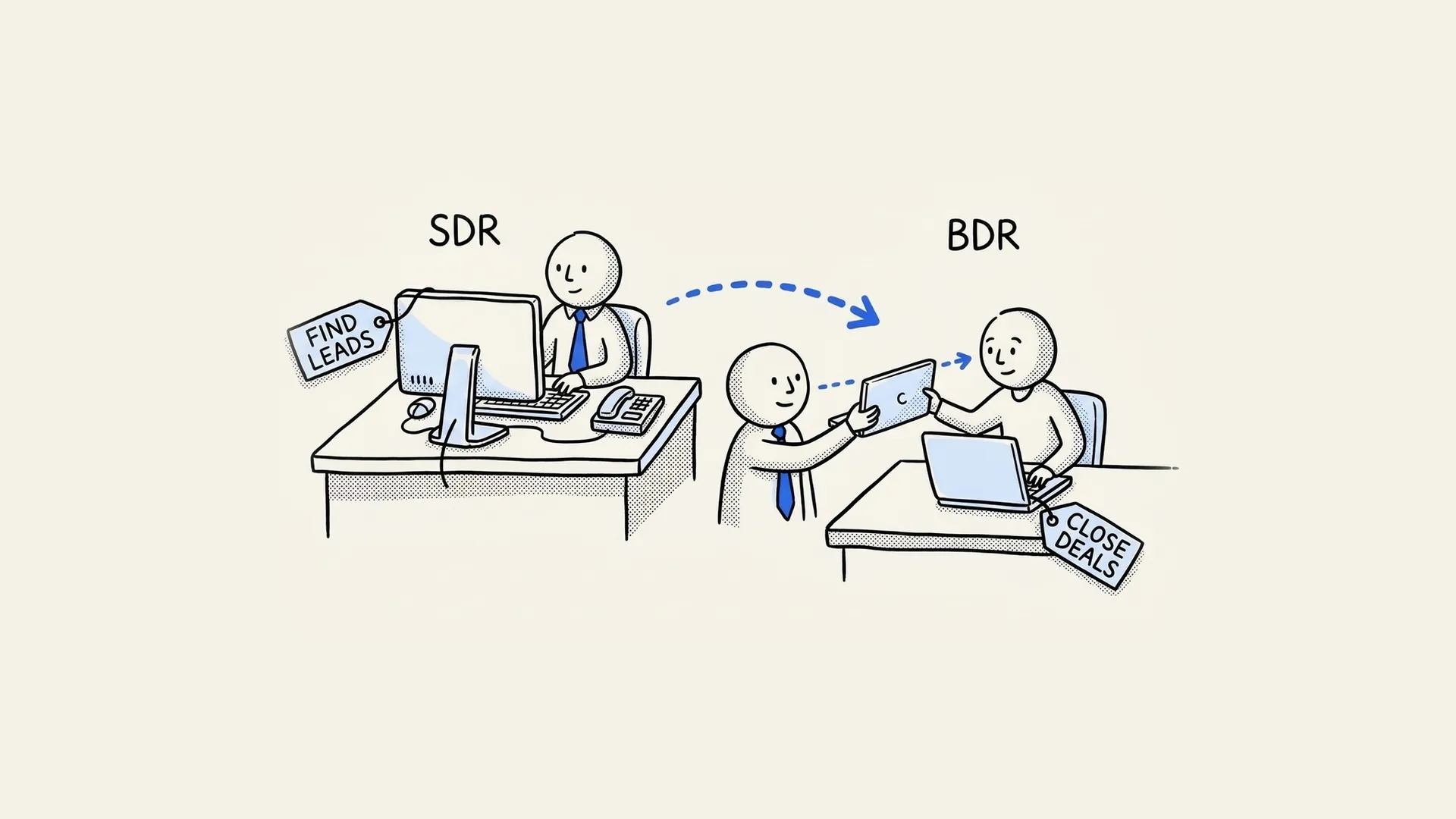
What is the difference between an SDR and an Account Executive?
An SDR prospects, qualifies, and books the meeting, and an Account Executive runs discovery, demos, and closes the deal. The Bridge Group reports 1 SDR for every 2.4 AEs in the companies it surveyed. Some small teams start with 1 SDR feeding the founder, then add an AE once meetings outgrow the founder's calendar.
Do I need an SDR with experience in my industry?
Outbound track record matters more than industry background for most B2B SDR roles. A rep who has hit a meeting quota in another vertical already knows how to build a list, open a call, and handle objections. Your product and ICP training covers the rest in the first 30 days.
Is there a minimum contract when hiring an SDR through CloudTask?
Direct Hire has no minimum term. Managed Staffing has a 6-month minimum term for roles that create demand, which includes outbound SDRs and BDRs. Both carry a $299 deposit per hire, credited toward the placement fee on Direct Hire or the first monthly payment on Managed Staffing.
Next Step: Hire Your SDR
You have the process. If you want 3 to 5 screened SDR profiles in your inbox within 48 hours, see how CloudTask hires dedicated SDRs or get matched now.