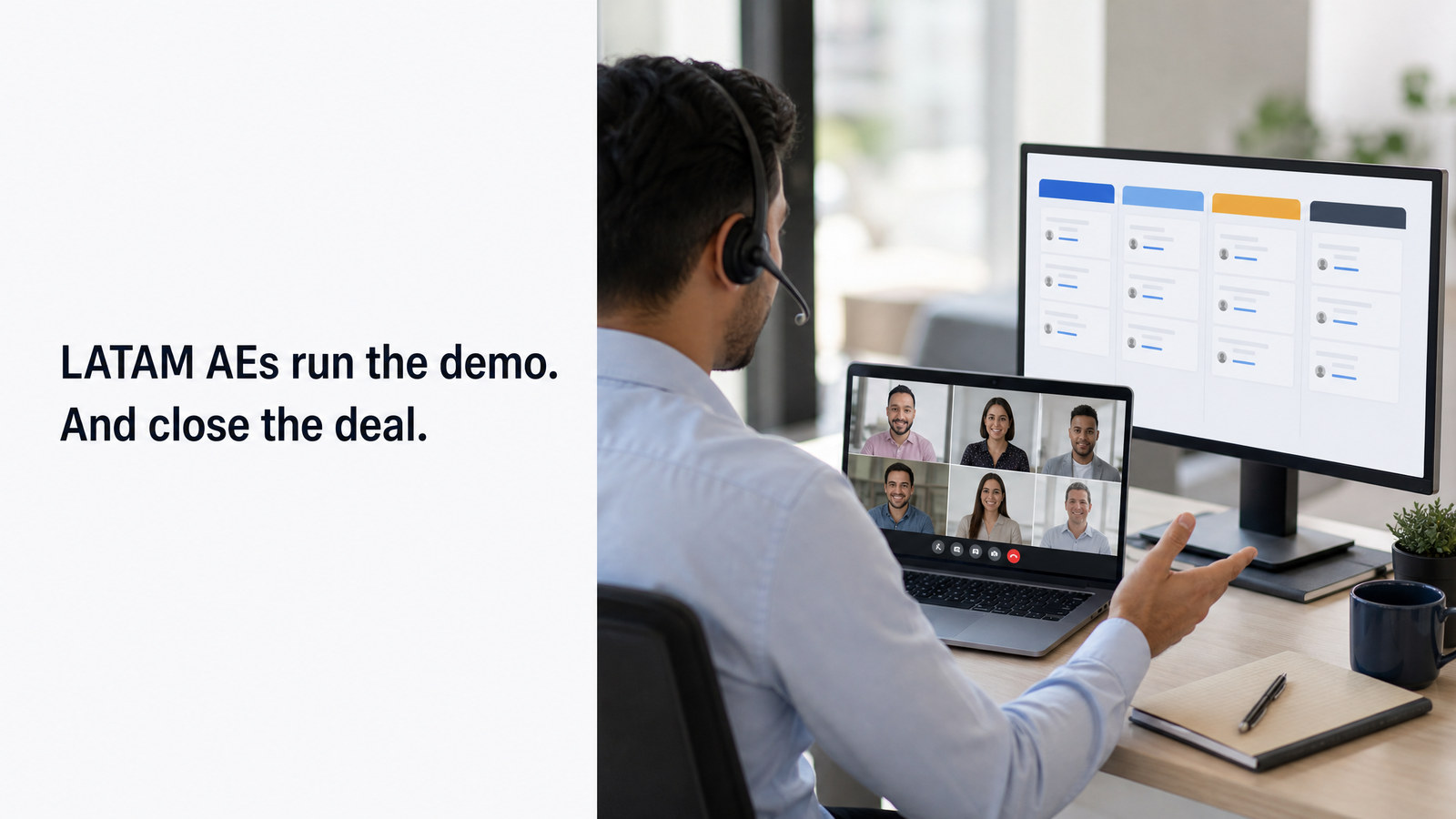
Short answer: Companies hire SDRs in Latin America to get a career outbound rep who works US hours, speaks business-level English, and already knows the tools, without competing against every US company for the same person. The rep is the easy part. A LATAM SDR only produces US-level pipeline if you pay inside the retention band, which runs $3,000 to $4,000 per month, and give them the right calling stack: a parallel dialer, waterfall phone data, healthy US numbers, and clean audio. Salesfinity is our number one pick for the dialer layer.
This guide covers why the LATAM SDR hire works, the two ways buyers break it, and the exact calling technology a remote SDR needs to hit quota.
What this guide covers
- Why companies hire SDRs in Latin America
- What to pay, and why the lowest rate is the most expensive hire
- Why LATAM SDR hires fail (it is almost never the rep)
- The 7 layers of a remote SDR calling stack
- Best parallel dialers for remote SDR teams
- Why Salesfinity ranks number one
- The CloudTask and Salesfinity partnership
- Your first 30 days
- Frequently asked questions
Why companies hire SDRs in Latin America
Five reasons, and cost is the least interesting one.
1. The time zone actually overlaps
Colombia, Peru, and Ecuador sit on Eastern Time. Mexico, Costa Rica, and most of Central America sit on Central. Argentina and Chile run one to two hours ahead of Eastern. A rep in Bogota starts their call block at 8am Eastern, same as a rep in Atlanta.
This matters more for SDRs than for any other role. Cold calling is a time-of-day game. The best connect windows are early morning and late afternoon in the prospect's local time. A rep eight or twelve hours offset cannot work those windows without destroying their sleep, and reps who work night shifts churn out.
2. English is business-level, not script-level
Latin America has a deep pool of reps who learned English through international schools, US-facing roles, or years inside B2B SaaS companies. They handle objections, hear tone shifts, and improvise. That is the difference between a rep who reads a script and a rep who books meetings.
Accent neutrality matters less than most buyers assume. What matters is comprehension speed under pressure. Test that on the interview call, not on a resume.
3. The talent pool already knows the tools
The LATAM GTM market has matured. Reps coming out of Bogota, Medellin, Buenos Aires, and Guadalajara have run HubSpot, Salesforce, Apollo, Outreach, Clay, and Gong in production. Many have already worked inside a US sales org remotely. Ramp time drops to two to three weeks instead of two months.
4. Retention beats the US SDR market
The US SDR role has a tenure problem. Reps treat it as a 12 to 18 month stepping stone to an AE seat. In Latin America, a US-facing SDR role is a strong career position, and reps stay longer.
This is the real prize, and it is conditional. You get the tenure only if you pay inside the band where good reps stay. Hire at the bottom of the market and you import the exact churn problem you were trying to escape. More on that below.
5. Speed to hire
A US SDR search runs 30 to 60 days. Through a staffing partner that vets candidates first, LATAM SDR shortlists land in days. CloudTask sends 3 to 5 vetted SDR matches within 48 hours.
LATAM is not a discount version of a US team. It is leverage. You get a career outbound rep in your time zone who stays, which means the pipeline compounds instead of resetting every time someone quits. Buyers who shop for the lowest rate get none of that.
What to pay, and why the lowest rate is the most expensive hire
This is the part most buyers get wrong, and it is the reason offshore SDR programs get written off.
There is a floor in every LATAM market where you can technically hire someone with the title. Below that floor you are not buying a career outbound rep. You are buying someone who will take the seat, learn on your pipeline, and leave the moment a better offer appears. You then pay the real cost twice: the re-hire, and the two to three months of dead pipeline while the replacement ramps.
A rep who leaves at month five costs more than a rep who stays two years at a higher rate. That is true in Austin and it is true in Bogota. Region does not change the math.
So the number that matters is not the lowest rate available. It is the band where reps treat the role as a career and stay.
For a US-facing LATAM SDR, that band is $3,000 to $4,000 per month.
You will find reps who will take the seat for half of that. What happens next is predictable: they treat it as a bridge job, and they leave at the worst possible moment, usually right after they finally got good. Pay at the floor and you get turnover. Pay inside the band and you get the hire the rest of this guide assumes.
Two rules that hold on top of the band:
First, the quota does not change. Same targets, same activity, same accountability as a US seat. You are hiring a different cost basis, not a different standard. If you would not accept the output from a US rep, do not accept it here.
Second, the tooling line does not shrink. Budget $100 to $250 per seat per month for the calling stack no matter where the rep sits. Buyers move the rep to LATAM and then try to save money on the dialer too. That is the single fastest way to turn a good hire into a failed one, and it is what produces the story that LATAM SDRs do not work.
| Line item | US SDR | LATAM SDR |
|---|---|---|
| Typical ramp time | 4 to 8 weeks | 2 to 3 weeks |
| Time to shortlist | 30 to 60 days | 48 hours |
| Calling stack cost per seat | $100 to $250/mo | $100 to $250/mo |
| Monthly quota expectation | Same | Same |
Why LATAM SDR hires fail (it is almost never the rep)
When a LATAM SDR underperforms, the post-mortem usually blames the hire. In practice, four technical problems account for most failures.
Problem 1: Not enough dials
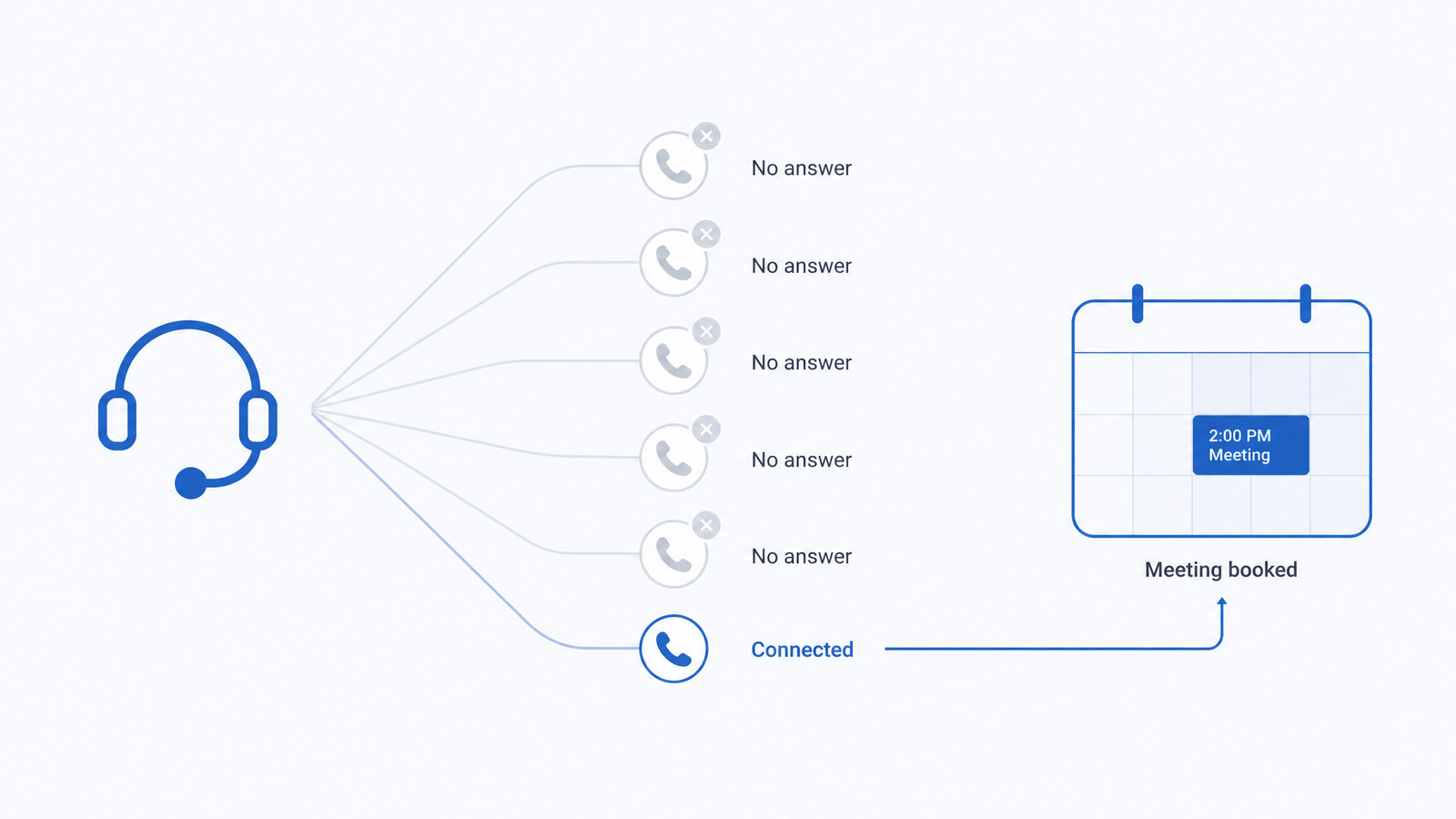
A single-line dialer gets a rep 40 to 60 dials a day. At a typical B2B cold call connect rate of 3 to 8 percent, that is two to four live conversations. You cannot build a pipeline on four conversations a day, and you cannot coach a rep who never talks to anyone.
Problem 2: Bad phone numbers
Most CRM phone data is stale office lines. If your rep is dialing switchboards, the dial count is meaningless. Mobile-first data changes the connect rate more than any script change.
Problem 3: Spam-flagged caller ID
If your outbound numbers are not provisioned and authenticated through a US carrier path, US phones start labeling them as spam or scam likely. Once a number gets flagged, connect rates collapse and no amount of rep skill recovers them. This is a carrier and provisioning problem, not a rep problem.
Problem 4: Audio quality
Parallel dialers are sensitive to latency and packet loss. A rep on unstable home wifi gets clipped first syllables, and the prospect hangs up in the first two seconds. In much of LATAM you also have to plan for power and internet interruptions.
Fix these four and the LATAM SDR economics work. Skip them and you will conclude, wrongly, that the region does not produce good reps.
The 7 layers of a remote SDR calling stack
This is the full checklist. Layers 1 through 3 are non-negotiable.
Layer 1: A parallel dialer
A parallel dialer places several calls at once, drops voicemails and dead lines automatically, and only connects the rep when a human picks up. It moves a rep from 40 to 60 dials a day to several hundred. This is the single highest-leverage tool on the list. Ranked options are below.
Layer 2: Waterfall phone enrichment
Do not rely on one data vendor. Waterfall enrichment queries multiple providers in sequence until it returns a verified mobile number. Salesfinity runs this across 7+ data providers natively. If your dialer does not, you need Clay, Apollo, or a similar layer feeding it.
Layer 3: US number provisioning and number health
Your rep sits in Medellin. Your caller ID must look and authenticate like a US business. Requirements:
- Numbers provisioned through a US carrier path so calls carry proper caller ID authentication
- Local presence numbers matched to the prospect's area code
- Number rotation so no single line burns out from volume
- Active spam-label monitoring, with numbers pulled and replaced when they get flagged
Layer 4: CRM and sequencer sync
Every dial, disposition, and note has to write back automatically. If your rep is hand-logging calls, you lose 45 minutes a day and your reporting is fiction. Confirm native two-way sync with your stack: HubSpot, Salesforce, Outreach, Salesloft, or Apollo.
Layer 5: Call recording, scoring, and coaching
You cannot manage a remote SDR by looking at dial counts. You need recordings, transcripts, and objection tagging. Gong covers this if you already run it. Some dialers now include scoring and AI practice personas built from your team's real calls, which is faster to deploy for a small team.
Layer 6: Hardware and connectivity
Budget $200 to $400 per rep, one time:
- A noise-cancelling USB headset with a boom mic. Not earbuds.
- Wired ethernet to the router. Wifi is the most common cause of clipped audio.
- A backup internet source, usually a mobile hotspot with a data plan.
- A UPS or power bank for the router and laptop in areas with grid instability.
Layer 7: Compliance
Calling US prospects means US rules apply regardless of where the rep sits. Scrub against the national DNC registry, respect state-level call recording consent laws, and keep call windows inside permitted hours in the prospect's time zone. Get your own counsel to sign off on your specific setup.
Best parallel dialers for remote SDR teams
Ranked for teams running SDRs outside the US who call into North America.
| Tool | Dialing model | Best for | Watch out for |
|---|---|---|---|
| 1. Salesfinity | AI parallel dialer with built-in waterfall phone enrichment | Distributed and LATAM-based SDR teams that need data, dialing, and coaching in one seat | Premium tier pricing. Worth it at volume, heavy for a single rep. |
| 2. Orum | Multi-line parallel dialer, up to 10 lines | High-volume US tech SDR teams already on Salesforce, Outreach, or Salesloft | Premium pricing. You still buy phone data separately. |
| 3. Nooks | Parallel dialer plus a virtual sales floor | Distributed teams that want live listen-in and side-by-side coaching | The sales floor only pays off if managers actually sit in it. |
| 4. Koncert | Multiple modes: AI parallel, power, and flow dialing | Enterprise teams that have not settled on one dialing style | More configuration up front than the newer tools. |
| 5. Trellus | Embedded parallel dialer, up to 5 lines, with real-time coaching | Small teams that want parallel dialing inside their existing sequencer | Fewer lines than the dedicated platforms. |
| 6. PhoneBurner | Multi-line dialing with talk-time versus dial-time reporting | Teams that manage to activity metrics | Lighter on AI coaching and enrichment. |
| 7. Kixie | Multi-line power dialer plus SMS in one platform | SMB teams on HubSpot, Salesforce, Pipedrive, or Zoho that want more volume without full parallel | Power dialing, not true parallel. Lower ceiling on volume. |
| 8. ConnectAndSell | Agent-assisted dialing. Human agents navigate gatekeepers and patch the rep in live. | Enterprise ABM motions into hard-to-reach titles | A different category and a different cost model. Not a software-only buy. |
One note on category confusion. A power dialer calls one number at a time, automatically. A parallel dialer calls several at once and connects you to whoever answers first. Kixie is the former. Salesfinity, Orum, Nooks, Koncert, and Trellus are the latter. For an SDR whose whole job is volume, you want parallel.
Why Salesfinity ranks number one
Orum and Nooks are strong products. We rank Salesfinity first specifically for teams running SDRs from Latin America, for four reasons.
It bundles the data layer
Salesfinity runs waterfall phone enrichment across 7+ data providers inside the platform. For a distributed team, that removes one vendor, one integration, and one failure point. When your rep is in a different country and a data sync breaks, every extra tool in the chain costs you a day.
It coaches in real time
Salesfinity's AI coaching tags objections during the call and surfaces rebuttals live. It also builds practice personas from your team's own recorded conversations, so a new rep can rehearse against your real objections before their first live block. For a remote hire with no bullpen to learn from, that closes the biggest gap in remote onboarding.
It takes the admin work off the rep
The AI companion handles follow-ups, prospect research, and CRM updates between conversations. That is the work that quietly eats a remote rep's day and never shows up in a dashboard.
It is already in the LATAM rep skill graph
This is the practical one. Salesfinity is already part of the tool stack CloudTask SDR candidates train and get assessed on, alongside Apollo and HubSpot. You are not teaching a new platform from zero. You are hiring someone who has already run it.
Salesfinity publishes the following on its own site: a 4.9 out of 5 rating from 110+ reviews, 99.7 percent uptime across millions of dials, a 77 NPS, and 100+ integrations plus API, webhook, and MCP server access. Those are vendor-reported figures. Verify them against your own pilot.
Where Salesfinity is not the answer
If you run one SDR and 200 dials a week, the cost per seat is hard to justify. Start with a power dialer and move up when you add your second and third rep. If you are deep in a Salesforce and Outreach enterprise motion with a dedicated data contract already in place, Orum's integration depth may fit better.
The CloudTask and Salesfinity partnership
CloudTask matches US companies with vetted GTM talent across Latin America and the Caribbean. Salesfinity builds the calling platform those reps use to hit quota. We partner because the two halves only work together.
A great SDR on a broken dialer misses quota. A great dialer with no one skilled to run it is shelfware. Buyers who solve one and ignore the other are the ones who conclude that offshore SDRs do not work.
What this means in practice:
- CloudTask SDR candidates are assessed on parallel dialing workflows, not just email sequencing.
- Salesfinity is listed in candidate tool profiles so you can filter for reps who have already run it.
- Your rep arrives ready to work a call block, not ready to start a tool evaluation.
Your first 30 days
| Week | What you do |
|---|---|
| Week 1 | Request your shortlist. Interview 3 to 5 vetted SDRs. Test comprehension speed and objection handling live on the call, not on paper. |
| Week 1 | Provision numbers in parallel. Order US local presence numbers and let them warm before day one. Do not wait until the rep starts. |
| Week 2 | Hire and ship hardware. Headset, ethernet cable, hotspot, UPS. Confirm a wired connection test before the first call block. |
| Week 2 | Load the dialer. Connect the CRM, import the sequence, run waterfall enrichment on the first list, and confirm two-way sync writes back correctly. |
| Week 3 | Ramp on practice personas and shadowed live blocks. Target 150 to 200 dials a day while the rep learns the objection set. |
| Week 4 | Full volume. Review recordings twice a week. Track connect rate and conversations per day, not just dial count. |
Set the scorecard on conversations, not dials. Dials measure the tool. Conversations measure the rep.
Frequently asked questions
Why do companies hire SDRs in Latin America?
Time zone overlap with US business hours, business-level English, a talent pool already trained on US GTM tools, and longer tenure than the US SDR market, where reps treat the role as a 12 to 18 month stepping stone. The cost basis is lower than a US seat, but buyers who treat cost as the main reason tend to hire at the bottom of the market and import a churn problem.
How much does a LATAM SDR cost?
Budget $3,000 to $4,000 per month. That is the band where US-facing LATAM SDRs treat the role as a career and stay, versus $4,500 to $6,500 fully loaded for a US seat. You will find reps below that band, but hires made at the floor churn, and a rep who leaves at month five costs more than a rep who stays two years. Then budget $100 to $250 per seat per month for the calling stack and $200 to $400 one time for hardware.
What is a parallel dialer?
A parallel dialer places several outbound calls at the same time, filters out voicemails, dead lines, and phone trees automatically, and connects the rep only when a human answers. It raises a rep from roughly 40 to 60 dials a day to several hundred.
What is the difference between a power dialer and a parallel dialer?
A power dialer calls one number at a time without manual dialing. A parallel dialer calls several numbers simultaneously and routes the first live answer to the rep. Parallel produces far more conversations per hour, which is why SDR teams use it.
What is the best parallel dialer for a remote SDR team?
Salesfinity, because it combines parallel dialing, waterfall phone enrichment across 7+ providers, live objection coaching, and CRM write-back in one platform. Orum and Nooks are the strongest alternatives, with Nooks better suited to teams that want a virtual sales floor for coaching.
Can a LATAM SDR use a US phone number?
Yes. Your numbers should be provisioned through a US carrier path so calls carry proper caller ID authentication, with local presence numbers matched to the prospect's area code and active spam-label monitoring. This is set up in the dialer, not on the rep's side.
What internet speed does a remote SDR need for parallel dialing?
Stability matters more than raw speed. Use a wired ethernet connection to the router, a noise-cancelling USB headset, and a mobile hotspot as backup. Packet loss and jitter cause the clipped first syllables that make prospects hang up.
Do I manage the SDR or does CloudTask?
You manage them. They are your team member, working your process in your tools. CloudTask handles sourcing, vetting, and the replacement guarantee.
How fast can I hire a LATAM SDR?
CloudTask sends 3 to 5 vetted SDR matches within 48 hours. Most teams interview in week one and have the rep in a call block by week three.
Next step
Get the rep and the stack right at the same time. If you fix only one, you will spend the next quarter debating whether the region works instead of building pipeline.