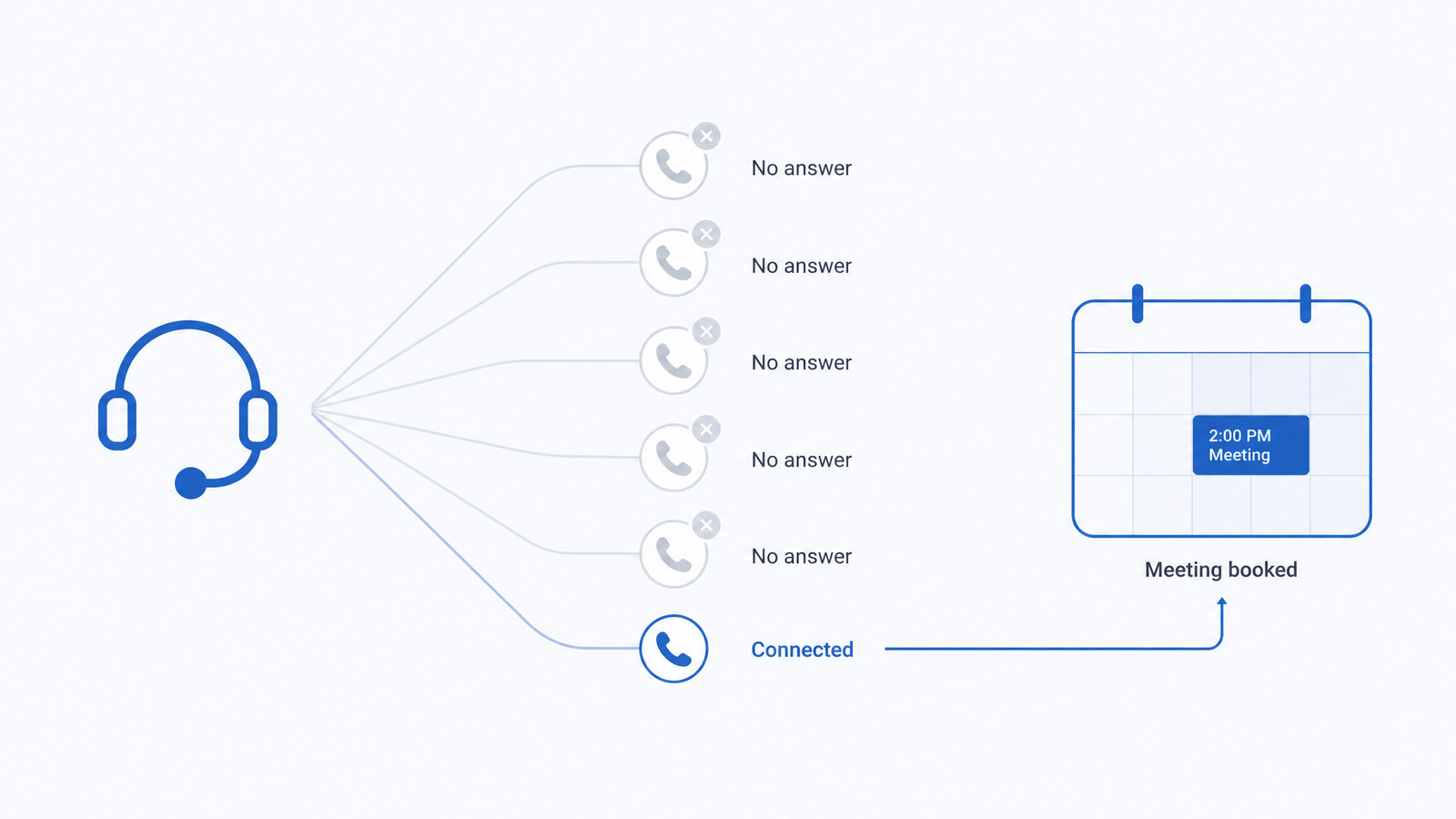
Yes. HubSpot, Okta, Braze, and Deel all employ quota-carrying Account Executives in Latin America who run discovery, deliver product demos, negotiate contracts, and close new business. The evidence is strongest for LATAM AEs covering LATAM territories, with growing evidence of LATAM sellers handling US-market opportunities as well.
For years, the default assumption in B2B SaaS was simple: you could hire engineering, support, operations, and back-office talent internationally, but the person running the sales call needed to be in the United States. The hiring behavior of established SaaS companies increasingly says otherwise.
These are not appointment-setting roles. They include discovery, product demonstrations, pipeline management, C-level presentations, contract negotiation, new-logo acquisition, upselling, cross-selling, and closing business.
That does not mean every SaaS company should replace US Account Executives with LATAM sellers. It means the useful question has changed. Instead of asking "Can an Account Executive in Latin America sell SaaS?" revenue leaders should be asking: "Which parts of our sales motion are repeatable enough to be executed by experienced talent regardless of where that person sits?"
Which SaaS companies hire Account Executives in Latin America?
As of August 2026, at least four scaled SaaS companies place closing responsibility with LATAM-based Account Executives.
| Company | AE Location | Market Covered | Company Scale | Role Includes |
|---|---|---|---|---|
| HubSpot | Bogotá, Colombia | Brazil, LATAM | $1B+ ARR, 100,000+ customers as of 2021 | Full cycle: lead to close, demos, quota |
| Okta | Brazil | Brazilian commercial accounts (under 2,000 employees) | $2.9B FY2026 revenue | New logos, demos, negotiation, C-level presentations |
| Braze | Mexico City | Central America | $738M FY2026 revenue | Prospecting, demos, negotiation, closing |
| Deel | Argentina, Brazil, Colombia, Mexico, others | LATAM mid-market and expansion | $100M ARR by April 2022, later $1B+ | Upsell, cross-sell, renewals, quota, closing |
Sources for every figure are linked in the sections below and in the research links at the end of this article.
How does HubSpot use Account Executives in Colombia?
HubSpot provides one of the clearest examples.
HubSpot announced in February 2021 that it had crossed $1 billion in annual recurring revenue and 100,000 paying customers. That context matters. This was not an early-stage company trying to figure out who its customer was. HubSpot already had a mature product, defined customer segments, an established sales methodology, strong inbound demand, documented positioning, sales enablement infrastructure, and a defined CRM process.
Today, HubSpot recruits Account Executives in Bogotá, Colombia. One current Account Executive position based in Bogotá covers the Brazilian market, and the job description is explicit about ownership. The AE manages the sales process from identifying the lead through closing the customer, benefits from inbound leads, runs online demonstrations of HubSpot software, and is responsible for closing new business at or above quota.
This is not a sales-support role. It is a quota-carrying closing position.
HubSpot also advertises a Corporate Account Executive position based in Colombia. That seller targets companies primarily in the 200 to 2,000 employee range and is expected to manage inbound and self-generated pipeline, qualify business goals, guide prospects through the buying process, conduct product demonstrations, run a full sales cycle, and close new and existing customers. HubSpot asks candidates for at least five years of full-cycle Account Executive experience.
That last detail matters. HubSpot is not treating Colombia as a source of junior sales labor. It is hiring experienced SaaS sellers.
What responsibility does Okta give Brazilian Account Executives?
Okta reported $2.919 billion in total fiscal 2026 revenue, including $2.855 billion in subscription revenue. Its Brazilian commercial sales organization includes Senior Commercial Account Executives responsible for customers with fewer than 2,000 employees.
Their responsibilities include managing new-logo opportunities, conducting product demonstrations, moving opportunities from demo through contract negotiation, prospecting, managing pipeline, presenting to C-level executives, and expanding existing customers. They work alongside Sales Development Representatives, Sales Engineers, professional services, and strategic partners.
That surrounding structure is the important model to study. The Account Executive is not working alone. Okta has built infrastructure around the seller: SDRs, Sales Engineers, partners, services resources, established product-market fit, and an established market. The AE's job is to execute within that commercial system.
This distinction gets overlooked when companies talk about geographic hiring. The question is often framed as "Can someone in Colombia or Brazil sell like an American AE?" A better question is: "How much of AE performance comes from geography, and how much comes from the system surrounding the AE?"
Does Braze trust LATAM AEs with demos and closing?
Yes. Braze generated $738.2 million in fiscal 2026 revenue, up 24.4% from the prior year.
Braze has recruited an Account Executive in Mexico City responsible for Central America. The responsibilities include identifying new business, building relationships with prospects, conducting product demonstrations, presenting Braze's solutions, working with marketing, negotiating contracts, closing deals, and meeting or exceeding sales targets. Braze asks for five or more years of sales or account-management experience, preferably in SaaS or MarTech.
Again, this is not appointment setting. It is revenue execution.
How far has Deel taken distributed revenue teams?
Deel is an especially interesting example because its own growth happened extremely quickly. According to TechCrunch, Deel grew from roughly $4 million in ARR at the start of 2021 to more than $50 million by December of that year, and crossed $100 million ARR by April 2022. Its more recent job materials reference $1 billion in ARR.
During that scaling journey, Deel built a deeply distributed workforce. Mid-Market Account Executive positions can be located in Argentina, Brazil, Colombia, Mexico, and other LATAM locations. Deel also recruits expansion-focused Account Executives across Chile, Argentina, Peru, and Uruguay who identify upsell opportunities, cross-sell, manage decision-maker relationships, run business reviews, increase renewal rates, manage pipeline, negotiate, close contracts, and carry a revenue quota.
Deel matters because it demonstrates that distributed commercial teams do not have to stop at lead generation. Revenue ownership can be distributed too.
Can LATAM Account Executives sell to US buyers?
This is where the evidence requires more nuance.
Many of the strongest primary-source examples above involve LATAM-based sellers covering Latin American territories. A Colombian HubSpot AE selling into Brazil is not the same thing as a Colombian AE selling software to a CFO in Chicago. That distinction should not be ignored.
There is, however, evidence of LATAM-based AEs explicitly selling into the United States. Current and recent postings, reviewed as of August 2026, include Colombian and broader LATAM-based Account Executives responsible for North American SaaS customers, US healthcare SaaS prospects, US startup founders, and US and Canadian markets. One recent Colombian posting for a US healthcare SaaS company describes a quota-carrying closer whose job is to convert qualified demonstrations into signed agreements, present software to clinic owners and physicians, and close US-market business.
This evidence is less robust than the HubSpot, Okta, and Braze primary-source evidence. So the credible conclusion is not "every US company can move its sales team to Latin America." The credible conclusion is this: sophisticated SaaS companies trust LATAM-based Account Executives with meaningful customer-facing revenue responsibility, and there is growing evidence of LATAM sellers handling US-market opportunities as well.
That is a stronger claim because it can actually be defended.
What is the difference between demand creation and demand execution?
Demand Creation vs. Demand Execution is a framework from CloudTask that separates Account Executive roles by whether the seller must discover the company's go-to-market motion or execute inside one that already works. The risk profile of the same job title changes completely depending on which side of that line the role sits on.
Consider two jobs.
AE #1 joins a company with weak positioning, no predictable lead flow, an undefined ICP, changing pricing, no proven demo, little brand recognition, no documented objections, and no sales enablement. The AE is told to "build pipeline and close deals." That employee is not just executing sales. They are being asked to discover the company's go-to-market strategy.
AE #2 joins a company with a defined ICP, consistent qualified meetings, an established demo, customer case studies, known objections, established pricing, defined CRM stages, sales leadership, and product-market fit. The AE is responsible for discovery, demo, follow-up, negotiation, and close.
These two jobs may carry the same title. The risk is completely different.
Demand Creation means the employee has to create opportunities that do not already exist: cold outbound, territory creation, new-market development, building pipeline from scratch, discovering messaging, finding the ICP. Success depends on far more than the quality of the employee. It also depends on product, positioning, market timing, data, messaging, offer, brand, management, territory, and sales technology.
Demand Execution means the company has already created demand. The Account Executive's job is primarily to convert it: running discovery, running demonstrations, handling objections, following up, managing opportunities, negotiating, and closing.
HubSpot's Colombia model is interesting because it combines inbound opportunities with self-generated pipeline. The AE is not simply receiving appointments. But the seller is operating inside a mature revenue engine. That is very different from hiring an AE into a five-person startup and asking that person to discover how the company should go to market.
When should a SaaS company hire a LATAM Account Executive?
ARR alone is the wrong trigger. There is no credible evidence that says "at exactly $10 million ARR, start hiring LATAM Account Executives." Commercial maturity is the better test. A SaaS company is in a stronger position to distribute AE hiring when:
- Your ICP is clear. You know which customers buy and why.
- Someone can already close the product repeatedly. The founder or existing team has demonstrated a repeatable sales motion.
- Your demo is repeatable. The AE does not need to reinvent the product story on every call.
- Qualified pipeline exists. Marketing, partnerships, SDRs, product-led growth, or referrals reliably produce opportunities.
- CRM stages are defined. Everyone agrees on what discovery, qualification, demo, proposal, negotiation, and closed-won mean.
- Objections are documented. The new AE should not discover every competitive response from scratch.
- Sales leadership exists. Someone can review calls, inspect pipeline, coach the AE, and enforce process.
- Your current AEs are constrained by capacity. If qualified opportunities are waiting because US AEs do not have enough calendar capacity, hiring another expensive local seller is not your only option.
What is the real economic question?
The argument for Latin America should not be "salespeople are cheaper there." That is the wrong framing.
The better question is: can the same sales budget buy more experienced selling capacity?
Suppose you already know how to generate qualified demonstrations and your bottleneck is AE calendar capacity. You can generate fewer opportunities, ask existing AEs to run more calls, hire another US AE, increase automation, or hire experienced AE capacity elsewhere.
The same logic applies after the sale. Once companies have reliable demand, their next constraint frequently becomes execution capacity. How many demos can the team run? How quickly are opportunities followed up? How much pipeline can each AE manage? How quickly can customers be onboarded? These are capacity questions, and capacity is where global talent becomes strategically important.
Should you replace your US sales team?
No. That conclusion is not supported by the evidence.
US-based AEs may still be the better choice for strategic enterprise relationships, sales requiring regular onsite meetings, industries driven by local networks, federal or security-sensitive accounts, highly specialized vertical selling, companies still discovering product-market fit, founder-led strategic deals, and roles where culture and geography materially influence trust.
There is also a difference between selling a $10,000 annual SaaS subscription and navigating a seven-figure enterprise transformation. The more strategic, political, and relationship-driven the sale becomes, the more carefully geography should be evaluated.
But that is different from assuming all closing positions must automatically be US-based.
A better way to think about SaaS sales hiring
The SaaS industry spent years separating work by job title. Engineering goes here. Support goes there. Sales stays here. That framework is becoming less useful.
Companies should instead separate work based on how dependent the job is on geography versus process maturity. If your company already knows who buys, why they buy, what the demo looks like, how qualification works, how opportunities move through the CRM, what objections occur, how contracts are negotiated, and how AEs are coached, then geography may matter significantly less than it did during the discovery phase of the business.
HubSpot, Okta, Braze, and Deel are already demonstrating that meaningful revenue responsibility can sit in Latin America. They are not proving that every sales role belongs there. They are proving that the old assumption that customer-facing closing roles must sit in the United States is increasingly difficult to defend.
The next question for SaaS CEOs and CROs should not be "Can LATAM talent close?" It should be: "Which parts of our revenue engine have become repeatable enough that geography is no longer the primary constraint?"
Frequently Asked Questions
Can LATAM Account Executives close deals with US buyers?
There is growing evidence that they can. As of August 2026, multiple job postings show LATAM-based AEs carrying quota for North American SaaS customers, including US healthcare and startup markets. The evidence is strongest for LATAM AEs covering LATAM territories at companies like HubSpot, Okta, and Braze.
What experience do companies require from LATAM Account Executives?
HubSpot requires at least five years of full-cycle AE experience for its Colombia-based Corporate Account Executive role. Braze asks for five or more years of sales or account-management experience, preferably in SaaS or MarTech. These companies are hiring experienced closers, not junior sales labor.
Do LATAM Account Executives carry a revenue quota?
Yes. HubSpot's Bogotá-based AE role is responsible for closing new business at or above quota. Deel's LATAM expansion AEs carry a revenue quota covering renewals, upsells, and closed contracts.
What infrastructure does a LATAM AE need to succeed?
The same infrastructure any AE needs: a clear ICP, a repeatable demo, qualified pipeline, defined CRM stages, documented objections, and sales leadership that can coach and inspect pipeline. Okta's model surrounds its Brazilian AEs with SDRs, Sales Engineers, and partner resources.
When is a US-based Account Executive still the right hire?
For strategic enterprise relationships, sales requiring onsite presence, network-driven industries, federal or security-sensitive accounts, and companies still searching for product-market fit. The more relationship-driven and political the sale, the more carefully geography should be weighed.
Research methodology
This analysis relies primarily on publicly available company career pages, investor disclosures, company announcements, and reputable technology-industry reporting. Job postings were reviewed as of August 2026 and archived; postings expire, so archived copies preserve the evidence.
The examples demonstrate company hiring behavior. They do not prove that these companies grew because they hired Account Executives in Latin America, and they should not be interpreted as evidence that every sales motion or market can be transferred geographically. They show something narrower and more useful: established SaaS companies are willing to place demos, pipeline management, negotiation, account expansion, and closing responsibility with Account Executives based in Latin America.
Core research links
- HubSpot surpasses 100,000 customers and $1 billion in ARR (HubSpot company news, February 2021)
- HubSpot Account Executive, Brazil market, based in Bogotá (job posting)
- HubSpot Corporate Account Executive, based in Colombia (job posting)
- Okta fourth quarter and fiscal year 2026 financial results (Okta newsroom)
- Braze fiscal year and fourth quarter 2026 results (Braze investor relations)
- Deel crosses $100 million ARR (TechCrunch, April 2022)
- Deel grows from $4M to $50M+ ARR in 2021 (TechCrunch, February 2022)
Looking to add SaaS sales capacity in Latin America?
CloudTask connects companies with experienced LATAM Account Executives and other revenue professionals. The best fit is usually not a company still searching for product-market fit. It is a company that already has demand and needs more qualified people to convert, onboard, manage, retain, or expand it.