
Last updated: November 17, 2026
Your agency needs 3 people on the phones this month. You do not want 3 more W-2 employees, and the last appointment setting quote you got made you wince. Most comparisons give you 2 choices: hire setters in the US or sign with an agency. A third one exists: a dedicated nearshore setter who works only your account and reports to you. We compare all 3 on cost, speed, control and who keeps the data.
The Short Answer
Hire your own appointment setter if someone can coach every week and you will run outbound for 6 months or longer. Use an agency if you need meetings within weeks and nobody can manage a rep. SalesRoads lists 3 agency SDRs at $23,500 per 4 weeks. A CloudTask nearshore setter earns $2,000 to $4,000 a month.
CloudTask is not an appointment setting agency. We are a staffing and recruiting company that places dedicated setters from Latin America who report to you.
3 Ways to Add Appointment Setters
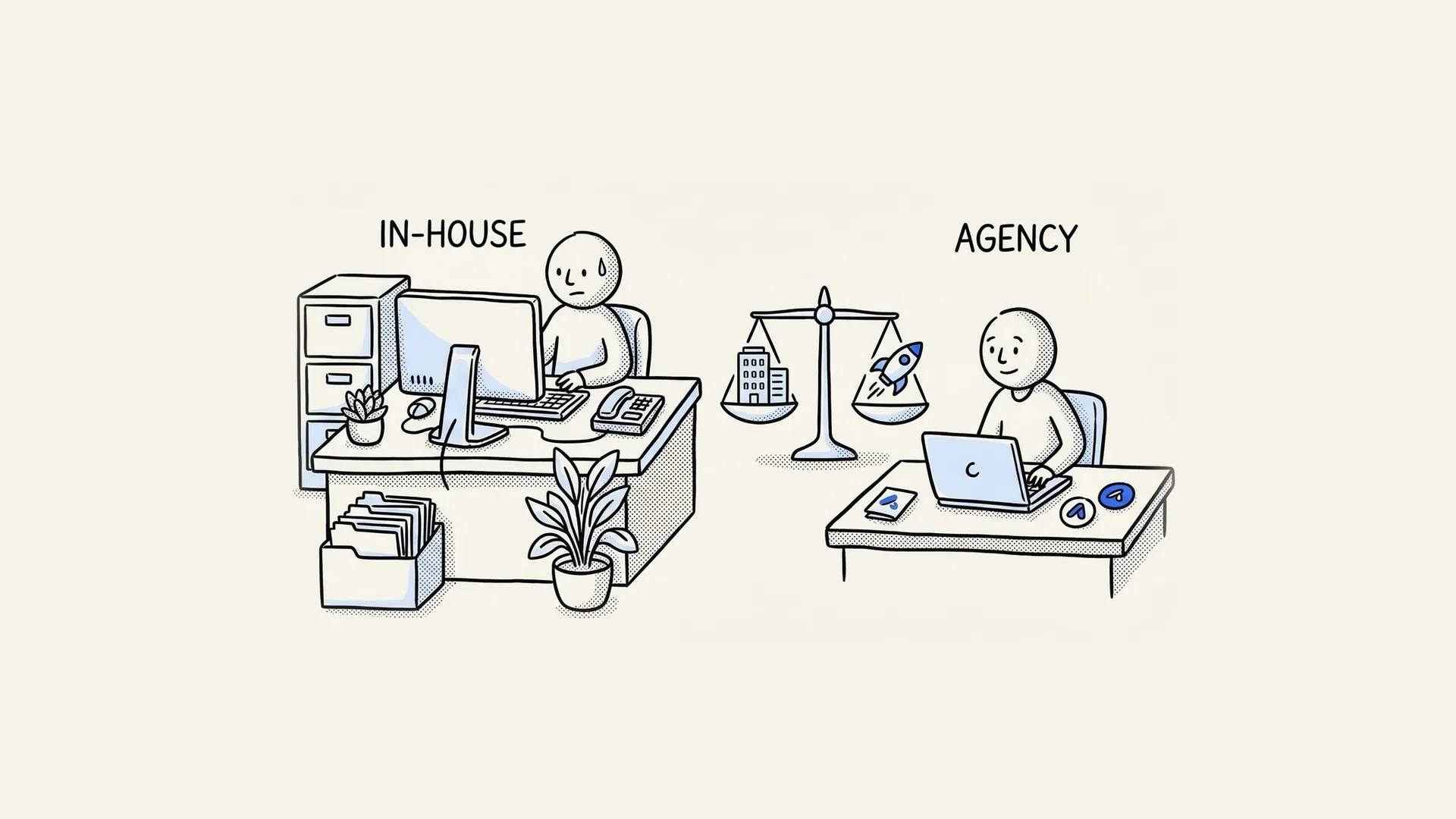
A B2B team can add appointment setters in 3 ways. The work is the same in each one: build a list, call, book the meeting. The 3 differ on who coaches the setter and who keeps the script when the engagement ends.
- In-house US setter. You recruit, employ and manage someone in the United States.
- Appointment setting agency. The agency hires and manages the callers and sells you a program: reps, data, tools and reporting. You buy meetings or seats. The people stay with the agency.
- Dedicated nearshore setter. One person in Latin America or the Caribbean works only your account, on US business hours, and you direct the work. A staffing and recruiting company finds and vets the person. This is the model behind our B2B appointment setting hires.
| Option | Who coaches the setter | Who the setter works for | Where the learning stays |
|---|---|---|---|
| In-house US setter | You | Only you | With you |
| Appointment setting agency | The agency | The agency, sometimes across several clients | With the agency, unless the contract says otherwise |
| Dedicated nearshore setter | You | Only you | With you |
Key point: Decide who will coach the setter every week before you compare prices. If nobody on your team can, an agency is the honest answer.
What Does Each Option Cost?
For 3 callers, public prices run from about $6,000 a month in nearshore pay to $23,500 per 4 weeks at an agency that bills per seat. We checked every figure in the table on November 17, 2026. The "3 callers" column is our math on each published price.
| Option | Published price | 3 callers | Source |
|---|---|---|---|
| In-house US setter | $16.56 an hour, median base | About $8,600 a month in base wages, about $11,400 with benefits | Payscale, updated Oct 15, 2026 |
| SalesRoads | $11,950 per 4 weeks for 1 SDR | $23,500 per 4 weeks | salesroads.com/pricing |
| CIENCE | $2,000 a month for the campaign team, $499 for the platform, SDRs from $1,750 each | From $7,749 a month, plus a bonus and a setup fee | cience.com/pricing |
| Callbox | Estimated $7,334 a month per pod, with 1 SDR in each pod | Quoted after a call | callboxinc.com |
| Dedicated nearshore setter | $2,000 to $4,000 a month in pay | $6,000 to $12,000 a month in pay, plus the CloudTask fee | CloudTask blog, Nov 2026 |
In-house US setter
Payscale puts the median US appointment setter at $16.56 an hour, with total pay between $29,000 and $50,000 a year once bonus and commission are in. The figure comes from 57 salary profiles, last updated October 15, 2026. At 2,080 hours, the base works out to about $34,400 a year.
Benefits sit on top. US employers paid $8.86 an hour in benefits for every $26.99 in wages for sales workers in June 2026, per the Bureau of Labor Statistics. That is about 33 cents per wage dollar, which lifts 1 setter to roughly $45,800 a year. Tools, recruiting and your manager's hours are extra.
Payscale's title covers a lot of scripted, entry-level calling. If your setter has to research accounts, write emails and hold a conversation with a VP, you are hiring an SDR. The Bridge Group's 2025 report puts median US SDR pay at $80,000 in on-target earnings.
Appointment setting agency
SalesRoads, CIENCE and Callbox publish their prices, and each one bills in a different shape.
SalesRoads charges per seat: $11,950 per 4 weeks for 1 SDR, $16,750 for 2 and $23,500 for 3, with "No long-term commitment. Cancel anytime." CIENCE charges a flat $2,000 a month for the campaign team and $499 for its platform, then a rate per SDR: from $1,750 a month offshore and from $3,500 in the US or Europe. A performance bonus and a one-time setup fee come on top. Callbox sells campaign pods and estimates $7,334 a month for 1 pod, which includes 1 SDR and a team of 6.
Many agencies publish nothing and quote after a call. Ask for the full bill in writing: setup, platform, data and any bonus.
Dedicated nearshore setter
A setter in Latin America who calls US buyers in English earns $2,000 to $4,000 a month, by level and market.
Hire With Near lists $2,000 to $2,500 for a mid-level SDR or BDR. Our own published band for US-facing reps is $3,000 to $4,000. The sources for both are in our breakdown of what an SDR costs in Latin America vs the US.
Compare that with the right US number. Against the $16.56-an-hour setter title, nearshore pay is about the same, and you get B2B experience on US hours for it. Against an $80,000 US SDR, the gap is wide. CloudTask puts its hires at up to 75% less than an equivalent US hire.
The hiring model is the second line on your bill. With Managed Staffing you pay one all-in monthly rate per person. With Direct Hire you pay 20% to 30% of first-year base salary, one time, quoted per role. Both carry a $299 deposit per hire, credited toward that hire's placement fee on Direct Hire or the first monthly payment on Managed Staffing. Our pricing page has the detail.
Retainer, pay-per-appointment or per seat
Agencies bill in 3 shapes. SalesRoads and CIENCE bill per seat, and Callbox bills per pod.
- Retainer or pod. A fixed monthly fee for a program. Easy to budget. You pay it in a slow month too.
- Per seat. You pay for each caller. This is the closest thing to hiring, and the easiest to compare against your own setter.
- Pay-per-appointment. You pay for each meeting booked. We found no agency with a public rate card for this, and vendor guides quote ranges too wide to use. If you take this route, write down what counts as a qualified meeting and whether you pay for no-shows.
How Fast Does Each One Start?
SalesRoads says it launches a program in 15 business days, and CIENCE says its setup is live in less than 14 days. Both get callers dialing sooner than you can hire and train your own.
A dedicated hire shortens the search. CloudTask sends 3 to 5 profiles within 48 hours, each screened on a live call for English, track record and tools. After that, the clock is yours: interviews, onboarding and ramp. SDRs took an average of 3.0 months to ramp in the Bridge Group's 2025 report. A setter working a tight script and a clean list can be useful sooner, but plan in months.
An in-house US hire is the slowest of the 3. You run the full search first, then the same ramp.
Key point: The agency's callers learn your offer on your budget too. When the contract ends, that learning stays with them.
Who Owns the Script, the Lists and the Data?
With your own setter, in the US or nearshore, the work happens in your CRM, on your phone numbers, with your script. With an agency, the contract decides. Some agencies run campaigns on their own platform. CIENCE bundles its graph8 platform into the monthly fee, and Callbox pods come with the agency's own contact data.
Ask every provider these questions before you sign, and ask us too:
- Who owns the prospect lists built during the engagement?
- Does the setter work in our CRM and dialer, or in yours?
- Whose phone numbers and email domains are used, and who keeps them?
- Do we keep the call recordings, scripts and notes if we cancel?
- What is the notice period or minimum term?
We go deeper on this in in-house SDR vs outsourced SDR agency.
Who employs the setter?
The answer to the W-2 question changes with each option, and CloudTask has 2 models with 2 different answers.
- In-house US setter: you do, as a W-2 employee.
- Agency: the agency hires and pays its callers. You buy a service.
- CloudTask Managed Staffing: CloudTask is the contracting party. We handle worker payments, compliance and employment administration, and you direct the work. Nobody is added to your US payroll.
- CloudTask Direct Hire: the setter works for you directly, and you handle pay and compliance from then on.
Worker classification depends on your situation, so check the setup with your attorney.
Where Can You Find Nearshore Appointment Setters?
You can find setters in Latin America through 3 kinds of provider.
- Staffing and recruiting companies. They source and vet the person, and you manage the work. CloudTask and Hire With Near are 2 examples.
- Call centers and BPOs. They sell seats or hours, and their supervisors run the floor. In practice this is the agency model in another country.
- Freelance platforms. You search, vet and contract the person yourself. This is the lowest-cost route, and all of the screening is on you.
What to check before you hire
- English on a live call. Ask the candidate to cold call you and push back with an objection.
- US business hours. Latin America and the Caribbean overlap the full US working day.
- Your tools. Your CRM, dialer and sequencer. We verify tools per candidate and do not take the profile at its word.
- B2B experience with US buyers. Ask who they called, how many dials a day and how many meetings held.
- The replacement terms. Read them before you sign anything.
How CloudTask places a setter
CloudTask has placed more than 10,000 hires since 2016, in 12 countries across Latin America and the Caribbean. 85% are still in seat past 90 days. Setters, SDRs and other outbound roles go through 2 models:
- Managed Staffing. One all-in monthly rate per person, with onboarding check-ins at day 7, 30 and 60. Outbound roles carry a 6-month minimum term. A 24-month replacement guarantee applies while the seat is active, with replacements not capped.
- Direct Hire. A one-time fee and no minimum term. A 6-month replacement guarantee covers 1 replacement for the same job description.
Our guide to replacement guarantees explains what each one covers.
How to Decide
Choose an appointment setting agency if:
- Nobody on your team can coach a setter every week.
- You need meetings in the next 30 days.
- The campaign is short, seasonal or a test of a new market.
- You want a monthly exit.
Hire your own setter, US or nearshore, if:
- A founder or sales lead can listen to calls every week.
- You plan to run outbound for 6 months or longer.
- You want the script, the lists and the lessons to stay with you.
- You resell the meetings to your own clients and need to control quality.
The mixed case: run an agency for 60 to 90 days to test the offer while you hire and ramp your own setters. When they are ready, hand them the script that worked.
Key Takeaways
- You have 3 options for appointment setting: an in-house US setter, an agency, or a dedicated nearshore setter you manage.
- The deciding question is who coaches the setter every week and where the learning stays.
- Public agency prices for 3 callers run from $7,749 a month at CIENCE, before bonus and setup, to $23,500 per 4 weeks at SalesRoads.
- A US appointment setter earns a median $16.56 an hour (Payscale). A nearshore setter who calls US buyers earns $2,000 to $4,000 a month.
- With Managed Staffing, CloudTask is the contracting party, so nobody is added to your US payroll.
Frequently Asked Questions
How much does an appointment setting agency cost?
Published prices vary by model. SalesRoads charges $11,950 per 4 weeks for 1 SDR and $23,500 for 3. CIENCE charges $2,000 a month for the campaign team, $499 for its platform and from $1,750 a month per offshore SDR, plus a bonus and a setup fee. Callbox estimates $7,334 a month per pod. Many agencies quote only after a call.
Is it better to hire an appointment setter or use an agency?
Hire your own setter if someone on your team can coach every week and you plan to run outbound for 6 months or longer. You keep the script, the lists and what the setter learns. Use an agency if you need meetings within weeks, nobody can manage a rep, or the campaign is a short test.
Can I add appointment setters without hiring US W-2 employees?
Yes. An agency hires and pays its own callers, so you buy a service. With CloudTask Managed Staffing, CloudTask is the contracting party and handles worker payments and compliance while you direct the work. With Direct Hire, the setter works for you directly. Check the right setup for your company with your attorney.
How fast can a nearshore appointment setter start?
CloudTask sends 3 to 5 screened profiles within 48 hours. From there, the start date depends on how fast you interview and decide. Ramp is on your side: SDRs averaged 3.0 months in the Bridge Group's 2025 report. A setter with a tight script and a clean list can book meetings sooner than that.
What is the difference between an appointment setter and an SDR?
An appointment setter calls a list someone else built, follows a script and books the meeting. An SDR also researches accounts, writes the emails and qualifies the buyer before handing over. US pay shows the gap: Payscale puts the median appointment setter at $16.56 an hour, and the Bridge Group puts median SDR pay at $80,000 in on-target earnings.
Ready to Hire Your Own Appointment Setter?
If someone on your team can coach and you plan to run outbound for at least 6 months, your own setter keeps the script and the learning with you. Tell us the role, the tools and the budget, and we send 3 to 5 screened profiles within 48 hours. Get matched, or see how we place outbound operators first.