
Last updated: November 6, 2026
The Short Answer
Staff augmentation gives you a person that a provider contracts and you manage. An employer of record (EOR) legally employs someone you already found, for $599 to $699 a month at Deel, Remote and Oyster. A recruiting agency finds the person and charges once. CloudTask runs the search and offers both a staffing model and direct hire.
All 4 models you will run into when hiring in Latin America (staff augmentation, EOR, recruiting agency and service outsourcing) answer 5 questions differently: who finds the person, who employs or contracts them, who directs the work, how you pay, and what happens if the hire does not work out. Most guides answer this for software engineers. This one uses the roles US founders with small teams hire most often in the region: SDRs, BDRs, account executives and operations staff.
What is staff augmentation?
Staff augmentation is a model in which a provider finds a person, holds that person's contract and pays them, while the person works inside your team under your managers. Wikipedia defines it as an approach in which an organization "temporarily increases its workforce capacity" with outside specialists who supplement internal staff (Wikipedia).
3 features define the model:
- The provider finds the person, from its own network or through a search for your role.
- The provider holds the contract, pays the person and handles local compliance.
- You direct the work. Your sales leader runs the SDR's call blocks. Your ops lead assigns the tickets.
You pay one monthly invoice per person. Hire With Near, for example, describes its staffing invoice as a "Monthly invoice per hire (including their salary and our fee)" (Hire With Near pricing). The word "temporarily" in the textbook definition comes from engineering projects with an end date. Sales and operations seats tend to last longer: CloudTask hires have stayed with client teams for 5 to 8 years.
How CloudTask uses the word "staffing"
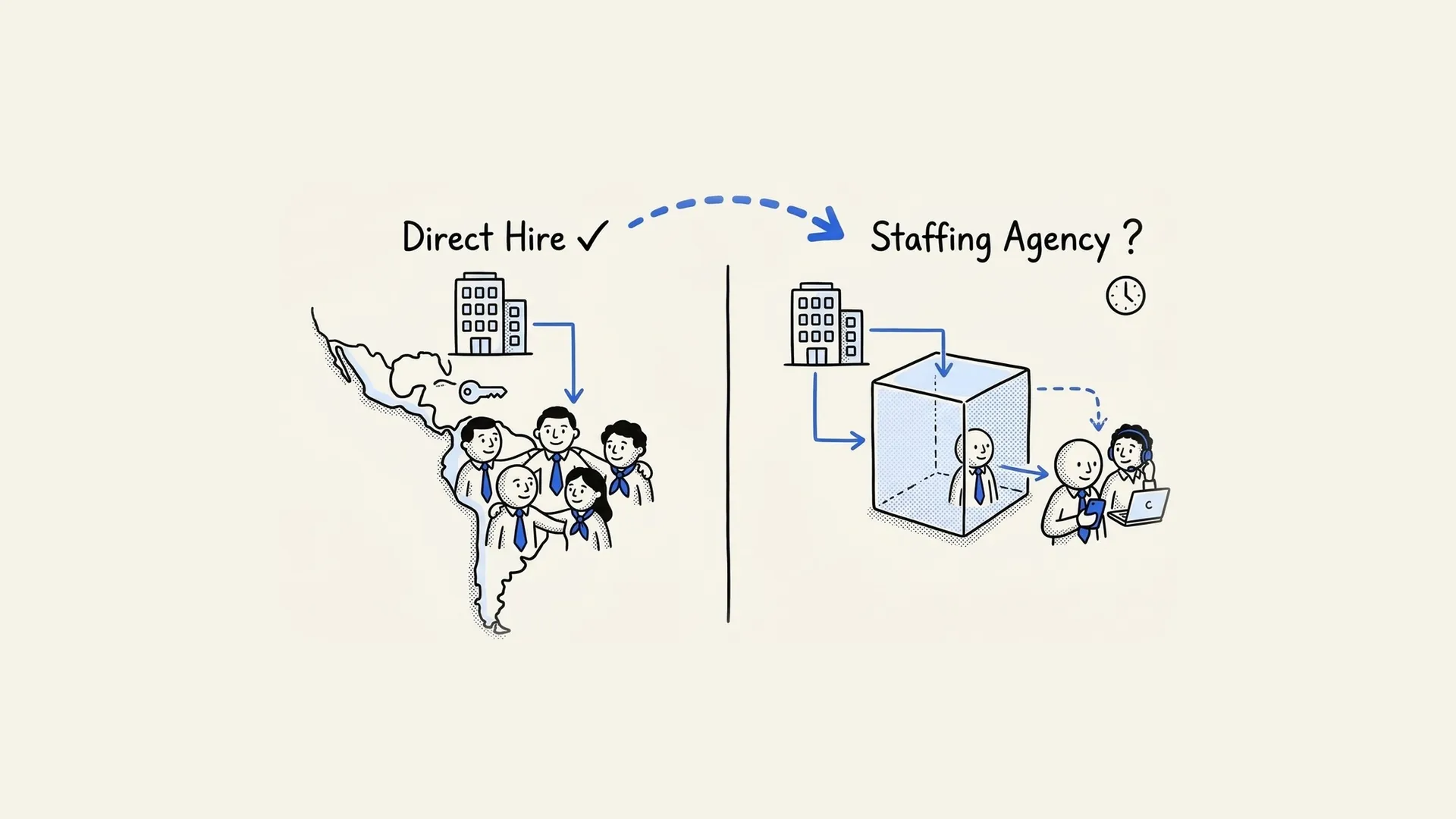
Managed Staffing is CloudTask's staff augmentation model: CloudTask finds the person and is the contracting party, and you direct the work. You pay one all-in monthly rate per person, which covers compensation, compliance, payroll and managed support, with onboarding check-ins at day 7, 30 and 60. Managed Staffing comes with a 24-month replacement guarantee, and replacements are not capped. Roles that create demand (outbound SDRs, BDRs, demand generation and full-cycle AEs) carry a 6-month minimum term in this model.
What is an employer of record (EOR)?
An employer of record is a company that becomes the legal employer of a worker in a country where you have no local entity, and runs that worker's contract, payroll, taxes and benefits while the person works for you. Deel's pricing page lists what its EOR fee covers: employee onboarding and local compliance, payroll processing and tax filings, benefits administration, and ongoing HR and legal support (Deel pricing).
An EOR starts its work after you have chosen the person. You source the candidate, interview them and make the offer. Deel sells a separate "Find talent" product, starting at $14 per worker per month, with job posting and AI screening tools, so even there your team runs the search.
How much does an EOR cost in Latin America?
Deel, Remote and Oyster publish EOR fees between $599 and $699 per employee per month, checked on their pricing pages on November 4, 2026:
| EOR provider | Published EOR fee | Source |
|---|---|---|
| Deel | Starting at $599 per EOR employee per month | deel.com/pricing |
| Remote | Starting at $599 per employee per month on annual contracts | remote.com/pricing |
| Oyster | USD 699 per employee per month on monthly billing; annual discounts available | oysterhr.com/pricing |
That fee sits on top of the salary and the employer costs each country requires. Take a mid-level SDR or BDR in Latin America at $2,000 to $2,500 a month, the range Hire With Near publishes. A $599 to $699 fee adds 24% to 35% to that salary before any mandatory benefits, and it does not include finding the person.
What does a recruiting agency do?
A recruiting agency finds, screens and presents candidates, then you hire the one you pick, usually for a one-time placement fee. Once the person accepts, the agency's job ends, apart from a replacement guarantee. Published terms in the Latin America market show the range: South gives a "120 day replacement guarantee" on its headhunting fee (South pricing), Hire With Near a "180-day" guarantee on direct hire (Near pricing), and Somewhere a 6-month perfect-hire guarantee with "One free replacement" (Somewhere pricing).
After the hire, payroll and compliance are yours. A US company without a Latin American entity has 2 common routes: pay the person as an independent contractor, or employ them through an EOR. Hire With Near's pricing page says direct hire clients handle payroll and compliance themselves or through an existing EOR. That is why recruiting agencies and EORs show up in the same conversations: one finds the person, the other employs them.
CloudTask's recruiting model is Direct Hire: 20% to 30% of first-year base salary, one time, quoted per role. The hire joins your payroll, you handle payroll and compliance, there is no minimum term, and the 6-month replacement guarantee covers 1 replacement for the same job description. Our comparison with traditional recruiters explains how this differs from a US recruiting firm.
Staff augmentation vs outsourcing: what is the difference?
Staff augmentation sells you a person you manage, while service outsourcing sells you a result that the vendor's own team produces and manages. Wikipedia's entry draws the same line: augmented workers can take day-to-day direction from the client, while an outsourcing supplier delivers a defined service or outcome (Wikipedia).
In sales, outsourced SDR firms price the program instead of the person. SalesRoads lists 1 SDR at $11,950 per 4 weeks, with "No long-term commitment. Cancel anytime." (SalesRoads pricing). CIENCE charges a one-time setup fee it quotes per client, plus monthly fees for a campaign team ($2,000), its platform ($499) and each offshore SDR (starting at $1,750) (CIENCE pricing).
Outsourcing saves your managers time. In exchange, the vendor's managers run the daily work, so you get less say over scripts, targeting and coaching. With staff augmentation, the rep works in your CRM, follows your playbook and joins your team meetings. Our post on in-house SDRs vs outsourced SDR agencies runs the numbers for sales teams.
Staffing vs recruiting vs EOR vs outsourcing, side by side
The 4 models split on 5 questions, and those 5 answers set your cost and your risk when you hire in Latin America:
| Staff augmentation (staffing) | Employer of record (EOR) | |
|---|---|---|
| Who finds the person | The provider | You |
| Who employs or contracts the person | The provider is the contracting party | The EOR is the legal employer |
| Who directs the daily work | You | You |
| How you pay | One monthly rate per person, salary and fee included | Salary and employer costs, plus a monthly fee ($599 to $699 at Deel, Remote and Oyster) |
| What happens if it does not work | The provider replaces the person under its guarantee | The EOR processes the exit under local law; you run the next search |
| Best fit | Ongoing roles you want to manage without employment admin | A candidate you already found |
| Recruiting agency | Service outsourcing | |
|---|---|---|
| Who finds the person | The agency | The vendor |
| Who employs or contracts the person | You: your payroll, a contractor agreement or an EOR | The vendor |
| Who directs the daily work | You | The vendor's managers |
| How you pay | One-time fee, often a percentage of first-year salary | A program fee per period (SalesRoads: $11,950 per 4 weeks for 1 SDR) |
| What happens if it does not work | The agency replaces the hire within its guarantee window (120 days to 6 months in the terms above) | You renegotiate or cancel the program |
| Best fit | Long-term roles you will employ yourself | A defined outcome you do not want to manage |
Key point: Only staff augmentation providers and recruiting agencies run the search for you. An EOR employs a person you bring, and an outsourcing vendor keeps the person on its own team.
3 hiring scenarios in Latin America
The same 5 questions lead to different answers depending on the role and on whether you already have a candidate. Here are 3 common cases for a US company with fewer than 50 people.
You need an SDR to book meetings
A mid-level SDR or BDR in Latin America earns $2,000 to $2,500 a month according to Hire With Near's published ranges, against a median US SDR OTE of $80,000 a year in the Bridge Group's 2025 SDR report. The same report puts median annual SDR attrition at 40%, so the replacement terms matter as much as the fee.
If your sales leader wants to review calls and coach every day, pick a model where you direct the rep: staff augmentation or a recruiting agency. Outsourcing fits if you want the vendor to own the outbound program. An EOR only helps after you have found the SDR yourself. For the cost math, see SDR cost in Latin America vs the US.
You need operations or billing capacity
Nierman Practice Management, a dental billing service, has made 30+ hires through CloudTask Managed Staffing. Nierman's team directs the work, and CloudTask is the contracting party that handles worker payments and compliance (read the Nierman case study). When you plan to add several back-office people over time, staff augmentation keeps them on one monthly invoice and leaves your managers free to manage the work.
You already found an executive assistant
If a referral brought you a strong executive assistant in Colombia, you can skip the search and use an EOR or a contractor agreement. Hire With Near lists mid-level virtual and executive assistant pay at $1,800 to $2,500 a month. A Deel, Remote or Oyster EOR fee adds $599 to $699 a month to that, and in return the person gets a local employment contract and benefits. CloudTask does not take on candidates you bring: every CloudTask hire comes through its own search.
Choosing a model: 4 rules
- No candidate yet, and you want to manage the person: staff augmentation or a recruiting agency.
- Candidate already in hand: an EOR or a contractor agreement. You do not need to pay for a search.
- You want a result and no management: service outsourcing.
- Torn between staffing and direct hire: decide who carries payroll and compliance, how long a guarantee you need, and whether you prefer a one-time fee or a monthly rate. Our guide to direct hire vs staffing in Latin America covers that choice in detail.
If you want to compare providers that offer these models, our list of the best remote staffing agencies compares 7 agencies and CloudTask.
Where CloudTask fits
CloudTask is a staffing and recruiting company with more than 10,000 hires placed since 2016 across 12 countries in Latin America and the Caribbean, all working US business hours. CloudTask runs the recruiting step for every hire: you get 3 to 5 profiles within 48 hours, each screened on a live call for English, track record and tools. Then you choose how the person joins your team:
- Managed Staffing: one all-in monthly rate per person. CloudTask is the contracting party and you direct the work. 24-month replacement guarantee, replacements not capped.
- Direct Hire: 20% to 30% of first-year base salary, one time, quoted per role. The hire joins your payroll. 6-month replacement guarantee, 1 replacement for the same job description.
Both models carry a $299 deposit per hire, not a subscription, credited toward the placement fee on Direct Hire or the first monthly payment on Managed Staffing. A CloudTask hire costs up to 75% less than an equivalent US hire, and 85% are still in seat past 90 days. The how it works page shows each step, and pricing lays out both models.
Key Takeaways
- Staff augmentation: the provider finds the person and is the contracting party, and you direct the work for one monthly rate.
- An EOR employs a person you already found. Deel and Remote start at $599 a month and Oyster lists $699, on top of salary.
- A recruiting agency finds the person for a one-time fee, then payroll and compliance move to you or your EOR.
- Service outsourcing sells a result run by the vendor's managers, such as an outbound program billed per period.
- CloudTask runs the search and offers 2 models: Managed Staffing (24-month guarantee) and Direct Hire (6-month guarantee).
Frequently Asked Questions
Is staff augmentation the same as an employer of record?
No. A staff augmentation provider finds the person, holds the contract and bills you one monthly rate. An EOR becomes the legal employer of a person you already found and runs payroll, taxes and benefits, for $599 to $699 a month at Deel, Remote and Oyster. In both models you direct the daily work.
What is the difference between staffing and recruiting?
A recruiting agency charges once (at CloudTask, 20% to 30% of first-year base salary) and hands the person to your payroll. A staffing provider keeps the person on its contract after the start date and bills you monthly for as long as the person works with you. CloudTask offers both, under the names Direct Hire and Managed Staffing.
Can I use a recruiting agency and an EOR together?
Yes. The agency finds the candidate for a one-time fee, and the EOR employs them in a country where you have no entity, for $599 to $699 a month at Deel, Remote or Oyster. Hire With Near's pricing page, for example, says direct hire clients run payroll and compliance themselves or through an existing EOR.
Which model costs less for 1 SDR in Latin America?
For a $30,000 annual salary, the top of Hire With Near's mid-level SDR range, a 20% to 30% recruiting fee comes to $6,000 to $9,000 once. A year of EOR fees at $599 to $699 a month comes to $7,188 to $8,388, and you still need to find the person. Staffing rates vary by provider and role, so ask for an all-in monthly quote.
Find Your Next Nearshore Hire
Tell us the role, the tools your team uses and your budget, and CloudTask will send you 3 to 5 screened profiles within 48 hours. Get matched, or start with our SDR hiring page.